



Comoros
'Les Cœlacanthes' is not just the nickname for Comoros’ national football team, which is currently chasing glory at the Africa Cup of Nations (AFCON) in Morocco.
It is also the name of a 410-million-year-old fish species that has become a symbol of biodiversity, national pride and identity.
Known locally as Gombessa, the coelacanth was considered extinct, until rediscovered off South Africa in 1938, with a second specimen found in Comoros in 1952, rewriting biology textbooks and placing the small island nation at the centre of one of science’s most extraordinary stories.
Today, Comoros is one of only a handful of known habitats for the coelacanth.
"Whether it's the national football team, basketball team, or individual athletes, everyone calls us the coelacanths. It is an integral part of our history and our heritage, and something we must preserve, just like our ocean," said Comoros Minister of Environment Abubakar Ben Mahmoud.
This heritage is on full display this December, as Les Cœlacanthes, Comoros’ national football team, is appearingfor the second time ever at AFCON.
While the players face their toughest challenge yet on the field, scientists are working just as intensely below the surface.
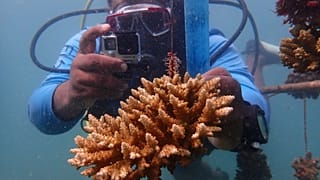
Through the First Descent: Comoros mission, the Government of the Comoros and Nekton, working with WILDTRUST under the R-POC programme from 6 October to 14 November, have completed the nation’s first systematic exploration of its ocean (from the surface to 900 metres).
Co-led by Dr Nadjim Ahmed Mohamed of the University of the Comoros, and supported by 17 Comorian researchers, the mission has documented previously unexplored marine habitats while establishing the first Comorian-led research programme dedicated to the coelacanth.
"First this species is very important to us because it is our national emblem. In fact, it is featured on our football team's jersey. Secondly, it's very special because scientists thought, or rather the whole world thought that this species was extinct," Mohamed explained.
For some, the resilience of the coelacanth also mirrors the trajectory of Comoros.
With fewer than one million people, the small nation hopes to rival bigger countries, whether in science or on the football pitch.
"The coelacanth is history — years and years of resilience," said Hamada Jambay, the manager of Comoros' national football team.
"It shows that Comoros will last. Like the fish, we were deep, and little by little we are rising up the table," he added.
After a difficult start against Morocco, Les Cœlacanthes is certainly hoping that the coelacanth’s history of survival is a good omen for its upcoming performances in the Africa Cup of Nations.





00:53
Liverpool condemns 'dehumanising, cowardly' racist abuse of Ibrahima Konate
01:00
Colombia: Baby grey titi monkey gets cuddly ‘mum’ ahead of return to wild
02:12
Senegalese fans in disbelief after AFCON victory overturned
01:07
AFCON 2025 final scandal: Senegal accuses CAF of corruption
00:55
Senegalese Football Federation bashes AFCON title stripping
Go to video
Appeal trial of 18 Senegalese nationals detained during AFCON final postponed