



China
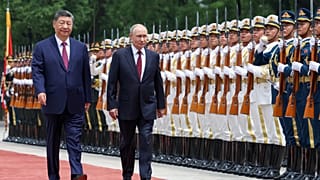
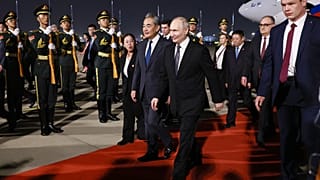
On the surface, Chinese leader Xi Jinping's back-to-back summits with U.S. President Donald Trump and Russia's Vladimir Putin looked pretty similar, with formal handshakes in Beijing's Tiananmen Square, an enthusiastic greeting from flower-waving children, and marching columns of soldiers branching gleaming bayonets. But the visits also revealed how different China's relationship is with the two countries.
During Trump’s visit, China sought to stabilize ties with the United States, while Putin’s trip served to deepen its strategic partnership with Russia. “There are more affinity between Putin and Xi, and I think more courtesy between Xi and Trump,” said Claus Soong, an analyst of Mercator Institute for China Studies (MERICS) based in Berlin.
While China and Russia reached more agreement, it is unclear what agreements were reached with the U.S., Soong added. In their back-to-back visits to Beijing, Trump and Putin both called Xi a friend and promised to work together with his government. But the two summits delivered markedly different messages, underscoring how different China's relationships are with the two countries.
Xi and Putin witnessed the signing of more than 40 cooperation agreements covering areas including trade, technology and media exchanges. The two leaders also signed a joint declaration describing Russia and China as “important centers of power in a multipolar world.”
Trump and Xi, by contrast, did not sign a joint declaration or witness the signing of any agreements during the visit. It was only after the U.S. president left Beijing that the two countries announced several accords, with Washington saying China had agreed to buy U.S. agricultural products at an annualized rate of $17 billion and purchase 200 Boeing jets.
Over the past six months, Beijing has hosted an unusually high number of world leaders, including several EU country leaders. Analysts sees the global governance system is shifting from an American-dominated one toward a multipolar order, with China increasing occupying the central position. Soong noted Trump’s unpredictability in diplomacy accelerated the process. "I think this meeting elevate(s) President Xi and also China as the major power," Soong said.


01:00
Pix of the Day, 30 September, 2026 - Across the world
01:31
Burundi agrees to accept third-country US deportees
01:00
Ukraine: Kharkiv apartment block hit by Russian strike, 25 injured
01:36
Trump-Xi summit: Pomp and pageantry, but few concrete breakthroughs
01:00
Ukraine: Russian drone barrage on Kyiv kills teenage boy and wounds 20 residents
00:51
Nigeria and US sign deal to increase mining investment