



Democratic Republic Of Congo
In the UK, a team of scientists who designed the first COVID 19 vaccine and who were involved in the 2013 Ebola outbreak are now working on a new vaccine to tackle the rare Bundibugyo type of Ebola responsible for the outbreak in Congo (DRC).
The current strain of Ebola currently claiming lives in Congo (DRC) has no vaccine or treatment.
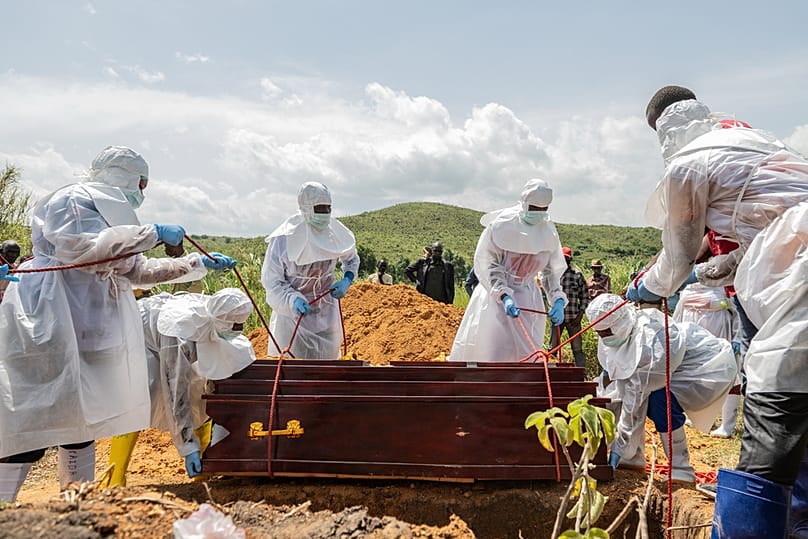
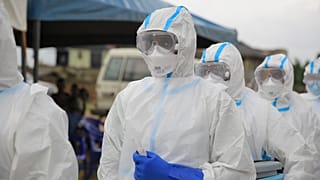
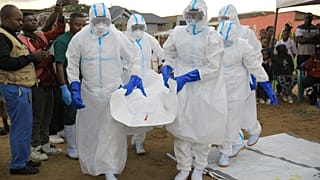
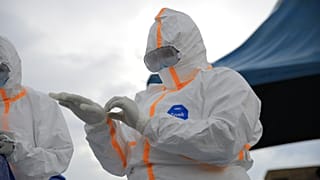
The return of the Ebola virus means once again, people in hazard suits carry out burials for funerals.
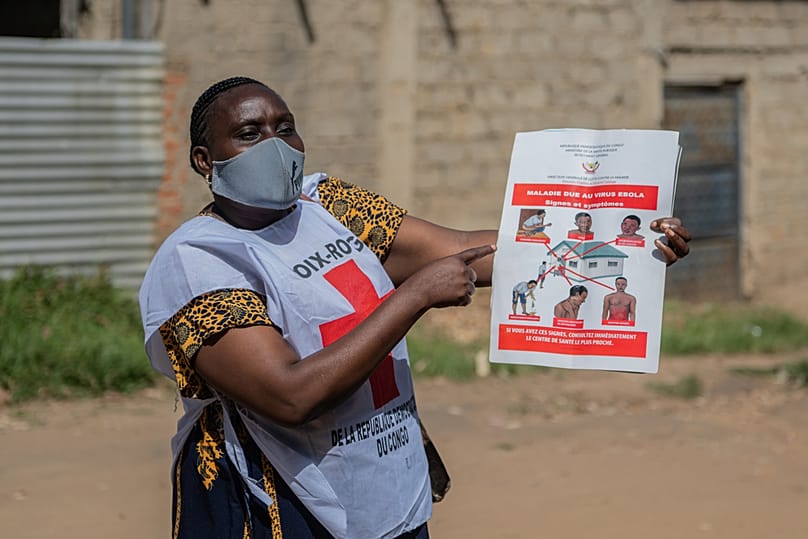
Health and aid workers are attempting to maintain a rigorous contact and tracing regime to contain the virus. They aim to track every person who has been in contact with anyone who has the virus.
As with the previous outbreak medical personnel are viewed with suspicion.
Prof Teresa Lambe is Head of Vaccine Immunology at the Pandemic Sciences Institute at the University of Oxford. She is one of a team of scientists who designed the COVID-19 Oxford/AstraZeneca vaccine, and also works on developing vaccines to stop epidemics like Ebola.
Lambe says contact tracing is a vital first stage in containing any outbreak.
"Truthfully, I think contact tracing and case isolation is absolutely the first thing that we should be doing and are doing in country, the WHO and the government bodies. And that is what we should be focusing to make sure that we've got all of the potential cases identified and hopefully under control," she says.
The Oxford Vaccine Group's experience in previous Ebola outbreaks has meant they have been fast off the blocks to begin development on a new vaccine to contain the Bundibugyo version of Ebola.
"We have been, able to pivot rapidly and to start to make a vaccine against the Bundibugyo, I think it's important to note that, I and others, many people within the field, were involved in the 2013, 2016 outbreak. I helped some of the testing of the vaccines that were tested for the Ebola outbreak. During that period. that amount of knowledge, has really helped us be able to, pivot and try and make a vaccine against this, that is happening in the DRC," says Lambe.
She explains how the Zaire Ebolavirus which struck in 2013 is different to Bundibugyo.
"The outbreak that happened in 2013 to 2016 and claimed over 11,000 lives was caused by the Zaire Ebolavirus and that is a filovirus that causes a quite high degree of disease and it's a haemorrhagic fever. Now, within that family of viruses, you have relatives, almost cousins if you will, that can cause disease. And one of those cousins for want of another word is Bundibugyo. So it is a virus that is like the outbreak causing virus from 2013 to 2016, but distinct enough that, we are accelerating new vaccines that target just that viral strain."
That epidemic a decade ago affected several countries in West Africa and is the worst on record.
There were more than 28,000 cases and more than 11,000 deaths as the highly contagious disease spread widely in Guinea, Liberia and Sierra Leone and spilled over into nearby nations.
A small number of cases were also reported in the United States, the UK, Italy and Spain linked to travellers from Africa or health workers returning home after helping with the outbreak.
No shortcut
But despite how quickly the scientists have acted Lambe is clear the vaccines being created for Bundibugyo today will not get through trials quickly enough to help the people now.
She says: "I'll be very blunt and say from the get go - there is no shortcut that we could or should or would want to take with human safety. So there is no test that we will not do. What we will try and do is run a number of those tests in parallel.
"So frequently when you're doing a vaccine development, it will take you 5 to 10 years because you will do one aspect, such as the pre-clinical testing, and then you will make a batch that can go into humans, and then you will start your phase one is so what we are trying to do now is to run those in parallel. So doing the animal testing along with the manufacture with humans and start the clinical testing as soon as we can. And we won't know whether these vaccines are effective or efficacious until we actually use them in an outbreak setting. So, truthfully, I wouldn't want to shortcut anything. But I'm mindful, as will, many people in the field, that we do these things in parallel. And when you do that, you do them at risk. And that's financial risk, because you don't know that your vaccine is going to be one that will be effective. But we certainly done this before for Covid and for other diseases. So that's why we're doing it again."
Public anger
In Congo suspicions have put aid workers at risk.
The country is experiencing conflict and armed groups have killed thousands of people and displaced many more in recent years.
Trying to get health messages about Ebola out to the people is difficult.
Trust is hard to find among the traumatised population that is wary of outsiders, even those trying desperately to contain the rapidly spreading outbreak that experts say was discovered weeks too late.
Surveillance for such diseases has been weakened by US and other aid cuts.
Ebola cases are nearing 1,000 but health centres are burned.
Three times in the past week, healthcare facilities have been attacked. On Sunday, angry young men stormed a hospital treating Ebola patients, forcing medical staff to evacuate them as gunfire rang out.
On Saturday, a group of residents set fire to a tent for suspected and confirmed Ebola cases run by Doctors Without Borders in Mongbwalu, and more than a dozen people suspected to have the virus fled potentially endangering many more people in their communities.
On Thursday, a centre in Rwampara was burned after relatives were barred from retrieving the body of a man suspected to have Ebola.
Anger is amplified as virus prevention practices keep loved ones from handling bodies in final rites following an illness.
People say death comes suddenly and dramatically, with vomiting and bleeding.
The Ebola virus is spread through close contact with sick or deceased patients’ bodily fluids, such as sweat, blood, faeces or vomit. Experts say healthcare workers and family members caring for patients face the highest risk.
Mortality risks
Lambe says details about the new strain aren't known, but they are believed to have different mortality risks.
She says: "So what we know from previous outbreaks of the other family members is that mortality can be 50 to 80 percent, whereas what we know from this, about this virus from the last two outbreaks is that mortality is lower. It's generally 30 to 50 percent. That's still pretty high and not something that, you know, you would you would want to catch and I think there's a lot of ongoing work that will delve into the epidemiology and the case fatality rates right now that is happening, that the W.H.O. and other partners in country are enabling. As to the spread. it is spread with true bodily fluids so individuals that have gotten sick and then they may have bodily fluids, especially when you're cleaning bodies of the deceased. That is how it is transmitted. So it is not as transmissible as something like Covid, nor is it as transmissible as something like measles."
There are few places to test for this Bundibugyo type in a region where clinics can run on generators, and a major airport serving as a humanitarian hub has been in the hands of rebels for more than a year.
Congo has had 17 Ebola outbreaks, and WHO says the country is equipped to respond. But early tests in this outbreak were conducted for a more common type of Ebola, losing valuable time. Experts are still trying to determine when this outbreak began.


02:00
Ebola: Sharp jump in cases in North Kivu while outbreak slows in Ituri
02:47
KoBold Metals uses AI to search for critical minerals in Congo
01:06
DR Congo confirms Ebola cases surpass 7,600 with 3,699 deaths
Go to video
Fairer vaccine sharing could save millions in next pandemic, study finds
10:00
Cameroon: Thousands flee the Far North after Boko Haram attack [Africanews Today]