



Democratic Republic Of Congo
As the number of Ebola cases continues to rise in the Democratic Republic of Congo, the authorities are struggling to isolate those suspected of having the virus.
An incident manager on the DRC’s national response team said patients believed to have the highly contagious haemorrhagic fever have mixed with the general population at the region’s hospitals.
“The first thing we have to do is a triage, remove all suspected cases from the hospital, place them in a temporary intermediate shelter, take samples, and have them analysed,” said Richard Kitenge.
Speaking in the city of Bunia, he said those who test positive with be taken to a special centres for treatment.
“Those who are not positive will be considered contacts that we will have to monitor,” he added.
One week after the confirmation of an outbreak in the country’s Ituri province, the special Ebola treatment centres set up to deal with patients in isolation remain empty.
In addition, health authorities are facing pushback from the community, who traditionally would perform a burial of a dead loved one - a practice forbidden during an Ebola outbreak.
On Thursday, an Ebola treatment centre in Rwampara was set on fire by youths angered after they were blocked from retrieving the body of a friend who had apparently died of the virus.
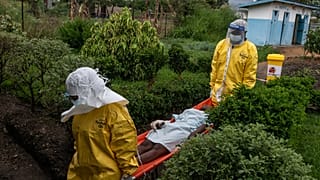
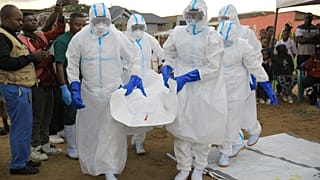
The bodies of Ebola victims can be highly contagious, and medical authorities are trying to control burials whenever possible.
Kitenge explained that the corpses of those who have died from the virus are far more dangerous than people who are sick.
"When there is a death, the internal cells, the cells that die, the virus resurfaces and it remains in the periphery. This means that everything that touches the body becomes contaminated, inevitably,” he said.
“To protect the population, we prohibit all contact with the corpse. Only trained personnel are allowed to touch it. So, not just anyone. The family has the right to see, but not the right to touch."
The World Health Organization on Friday said the outbreak is spreading rapidly and now poses a “very high” risk nationally.
There are now almost 750 suspected cases and 177 suspected deaths.
But both the WHO and Africa Centres for Disease Control and Prevention believe the outbreak is larger than the number of cases detected so far.
This latest epidemic is caused by the much rarer Bundibugyo virus. By the time this was discovered, dozens were already dead.
Containing the outbreak is complicated by the fact that there is no vaccine or specific treatment for the strain.
02:00
Ebola: Sharp jump in cases in North Kivu while outbreak slows in Ituri
00:59
Guinea opposition figure and former PM Toure dies in Paris
01:01
Tenth woman found dead in South Africa's string of mystery killings
01:06
DR Congo confirms Ebola cases surpass 7,600 with 3,699 deaths
01:41
Congo launches Ebola vaccination campaign for frontline workers
Go to video
Student pilot and flight instructor killed in Kenya plane crash near wind turbines