



Egypt
Egypt has opened the tombs of Amenhotep-Rabuia and his son Samut in the Al-Khokha archaeological area on Luxor's West Bank.
The tombs are decorated with scenes of activities including agriculture, crafts, and wine production.
"The importance of these tombs is that they date back to the New Kingdom, specifically the 18th Dynasty, the reign of Thutmose III and Thutmose IV, a period when Egyptian civilisation was at its peak," says Bahaa Abd El Gaber, Director of Antiquities of the West Bank of Luxor.
"The scenes painted on the walls represent the richness of the civilisation during that era."
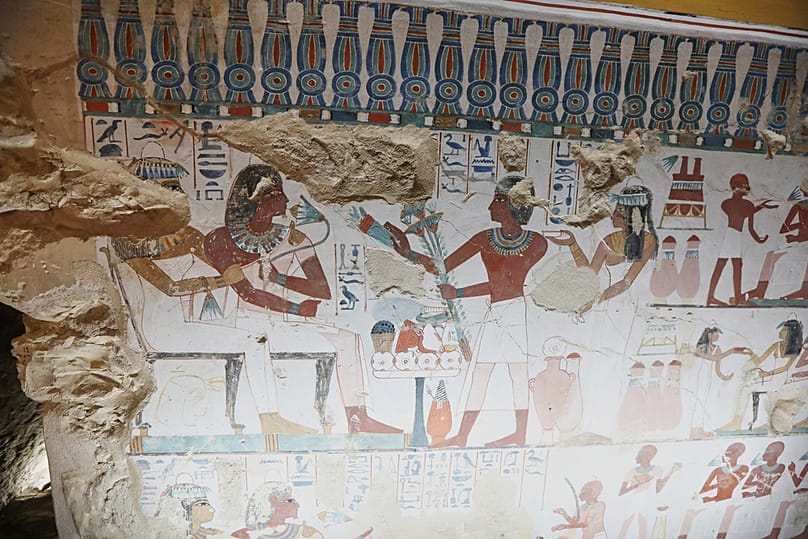
Rabuia and Samut served as door keepers to the god Amun, according to Egypt’s tourism ministry. Despite their relatively low rank, the ministry said the tomb paintings are among the masterpieces of ancient Egyptian art.
"These tombs, like most of the tombs on the West Bank [of Luxor], have been vandalised. However, the historical value of these tombs is that the inscriptions and paintings on the walls are in a perfect condition,” says El Gaber.
Both tombs follow the T-shaped architectural style commonly used for noble tombs during Egypt’s 18th Dynasty.
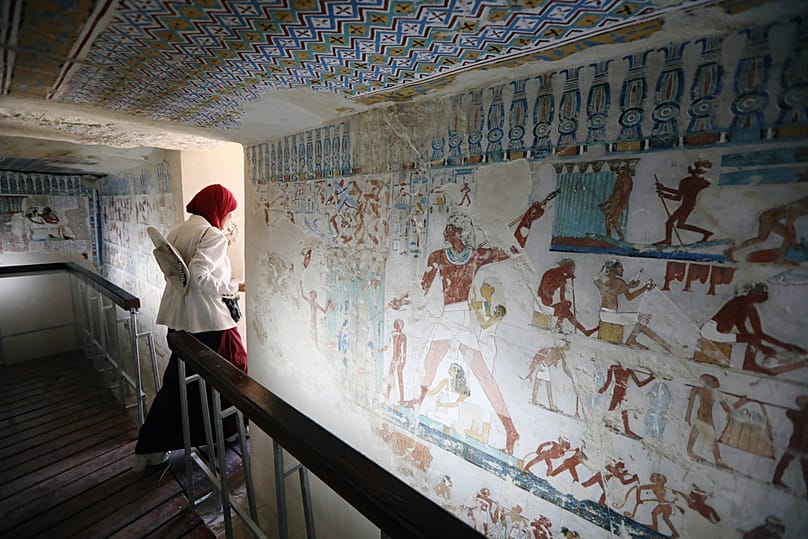
The transverse hall of each tomb is decorated with scenes from the owner’s life, while the long hall is decorated with funerary scenes, the transportation of funerary furniture in the presence of the gods Osiris and Hathor.






01:13
Egypt: Sufi muslims celebrate Mawlid al-Nabawi in Cairo
00:50
At least 18 killed in Egypt truck crash, many children
01:47
Sudan's civil war threatens ancient pyramids of Meroë
01:00
Most realistic ancient roman faces revealed at Budapest exhibition
01:29
Syria unveils archaeological treasures returned from France after 15 years
02:25
Libyan archaeologists battle to save ancient Greek ruins in east of country