



Guinea
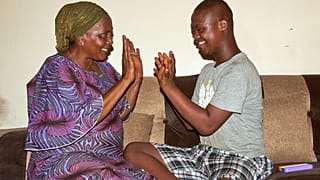
Kazaliou Baldé’s parents started worrying about him when he was a small child because he avoided eye contact and had difficulty communicating.
His family, who live in the village of Fria in Guinea, at first turned to a traditional healer who suggested protective amulets.
But when he dragged himself along the ground instead of walking, they decided to take him to a hospital in the capital, Conakry.
There he was diagnosed with autism, something the family had not heard of before.
With the disorder widely misunderstood in Guinea, neighbours were rude to him with some even suggesting that his parents take him to the bush and leave him there.
“Those words really hurt me a lot. Even so, I took him with me when I sold at the market. It was hard because he had trouble sitting still,” said his mother Kadiatou Diallo.
The complex developmental condition now known as autism spectrum disorder, affects people in different ways, including delays in learning or social skills.
With little information and government support available, misconceptions are common around the disorder which some mistakenly attribute to evil spirits.
Experts say this has often delayed diagnosis and resulted in children and their families being stimatised.
"People talk about him a lot [in a negative way]. Since my husband passed away, I've been taking care of my child. Before he died, he used to help me," said Diallo.
Guinea’s government does not keep records around autism.
The World Health Organization says about one in 127 people worldwide had autism in 2021, but it notes that the prevalence in many low- and middle-income countries remains unknown.
"In our Guinean culture, children like this are rejected. It is a real ordeal for the parents. The government must step in and help these families," said Dr Alhasane Cherif, a clinical psychologist in Conakry.
In Guinea, a nation of about 15 million people, only a few schools cater to children with autism, and they can cost up to $300 per month.
Not many families can afford that in a country where the minimum wage is $65 a month, and where t43.7 per cent of citizens live below the poverty line, according to the World Bank.
With few resources available to support parents of autistic children, Diallo fought hard for her son to get an education.
He first attended private and public schools, but his teachers did not introduce him to writing and reading, with teachers saying he had “no provision for school”.
Now, a rare free school in Fria is offering families like hers some hope.
"We're here, fighting, because we've come to understand that these children are precious," said Houssainatou Diallo, advocacy officer at the Salim Foundation for Children with Autism.
"They just need help, support and guidance on how to navigate life and how to live as part of the community," she said.
At the school, children like Kazaliou are taught basic things like identifying objects and assembling toys, as well as everyday skills such as operating a TV remote.
Last year, it organised what it called the country's first international seminar on autism, with its founder saying children with autism deserve acceptance in society.
Despite this, the now-15-year-old Kazaliou has to spend his time outside school away from many community members who still attribute his condition to an unknown “evil" and want him shunned.
01:57
Border between DR Congo and Rwanda reopens amid Ebola outbreak
01:15
Ebola outbreak: UN projects $3.6 billion cost for Africa in worst case
01:06
Ebola outbreak in DR Congo spreads to fourth province
01:29
Guinea PM Rejects China's 'Debt Trap' Criticism, Says Africa Must Take Responsibility
02:12
Ebola: Health workers battle virus and stigma
02:10
Anguish and fear as students remain in captivity in latest Nigeria kidnappings