



sahel
With parts of Northern Europe experiencing sweltering May temperatures, scientists are warning that it’s only going to get worse.
Parts of Northern Europe have been basking in unseasonable spring heat this week.
A new report by World Meteorological Organization suggests this may soon be the norm.
The report authored by the WMO and UK Met Office predicts global temperatures over the next five years.
Now the new United Nations climate projections forecast a high likelihood of more speeded-up warming through to 2030, with Earth smashing its record for the hottest year and regularly surging past the international climate limit set in 2015.
A hotter globe means more extreme weather including floods, droughts and heat waves such as the one Europe experienced this week, scientists say.
There’s a 91 percent chance that at least one of the next five years will shoot past the 1.5 degree threshold and an 86 percent chance that one of those years will smash the record for Earth’s hottest year set in 2024, the WMO report said.
The WMO projects each year between now and 2030 to be between 1.3 degrees Celsius (2.3 degrees Fahrenheit) and 1.9 degrees Celsius (3.4 degrees Fahrenheit since the late 1800s.
"The next five years we're expecting temperatures to be above average basically everywhere in the world especially over the northern hemisphere and over land as well. We've got a very high chance of at least one year in the next 5 exceeding 1.5 degrees so there's a 91 chance of this and there's also a 91 percent chance that the next five years will be warmer than the previous five years so the science is very clear. The climate is warming and the global average temperatures are continuing to rise and it's very clear that we need to take urgent action to reduce this as much as possible,” says Melissa Seabrook, one of the authors of the report.
Just look at what's happening in Europe, where unprecedented May heat records were smashed, says Seabrook, a climate scientist at the U.K. Meteorological Office “In a warmer world, we, we expect to see, these exceptional weather events to occur more and more, frequently.”
She says it's becoming clear the Paris climate agreement is not likely to hold.
"It is becoming more and more likely that we're not going to be able to keep underneath this threshold and it would take extreme mitigation to be able keep our global warming to 1.5 degrees. But it is important to note that it's not kind of a threshold, those temperatures suddenly won't, nothing will drop off a cliff when we reach 1. 5 degrees and every kind of 0.1 of a degrees has more and most severe impacts. And it's important to kind of keep that in mind that it is not a cliff edge. But it is very important to try and limit our warming as much as possible," explains Seabrook.
Amazon wildfires
And if the next five years does average more than 1.5 degrees Celsius since pre-industrial times that means Earth will have warmed a quarter of a degree Celsius (0.45 degrees Fahrenheit) in a decade, which is faster than rates of warming about two-tenths of a degree Celsius per decade before 2022.
The next five winters in the Arctic is predicted to be 5 degrees Fahrenheit (2.8 degrees Celsius) warmer than the average for 1991-2020 and Arctic sea ice is likely to keep dropping.
"The Arctic in particular, is warming at a much higher rate than the rest of the world. So it's warming like 3.5 times faster than the rest of the globe," says Seabrook.
She explains this is a process called Arctic amplification: "So basically as the sea ice and snow melts in the Arctic, you lose that kind of mirror effect because the snow and the sea ice was reflecting solar radiation back up to space. And as those melt, you kind of lose that. So you get more solar radiation being absorbed, which means that basically the temperatures are increasing at a much larger rate so we're getting like this positive feedback loop happening. As temperature warms, more sea ice melts. The worse this makes it, so yeah, this is Arctic amplification."
Floods in the Sahel
Projections also anticipate dangerous drought with potential wildfires for the Amazon, a crucial part of Earth's natural defences against human-caused climate change.
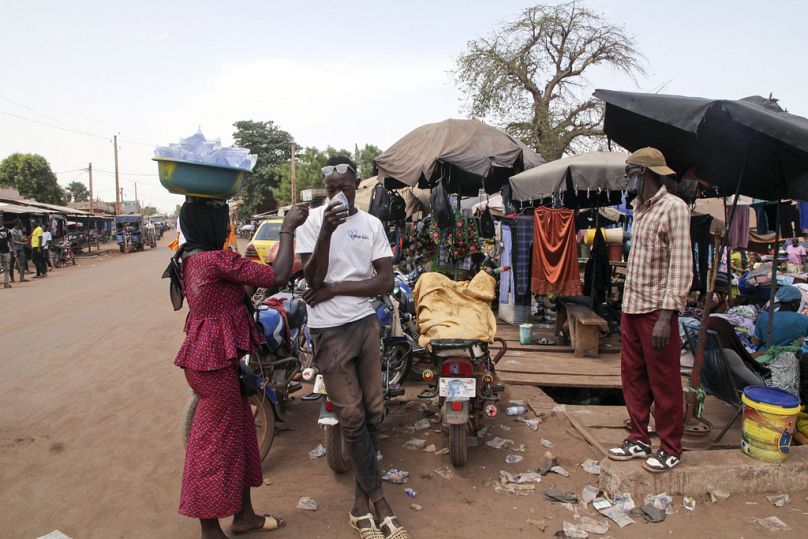
If the WMO projections are fulfilled the Sahel in Africa could experience flooding.
The Sahel is described by the UN's Development Program as a 5,000 kilometre belt of land below the Sahara Desert, stretching from Africa's Atlantic coast to the Red Sea.
Seabrook says: "Yeah, so the Sahel is a particularly interesting region because it's been affected by quite bad droughts in the last 30 years. So wetter-than-average conditions over Sahel might potentially mean that there's going to be less droughts basically there. So it could mean a better growing season but it also could increase the likelihood of flooding events in that region where it isn't kind of used to experiencing much rainfall."
The report is based on the averaging of about 200 runs of computer simulations using 13 different climate models from various countries, Seabrook said.


00:57
Tunisia says 2026 summer hottest on record, temperatures topped 49.7°C
02:36
Burkina Faso farmers growing pineapples amid push for self-sufficiency
01:17
Niger's military 'gradually regaining control' after mutiny at military base
01:01
Reports of gunfire near military base in Niger's capital
02:00
Algeria’s north-east scorched by deadly wildfires, national mourning declared
11:19
Ecowas : will the ECO finally become a reality in 2027? [Business Africa]