



Algeria
After decades in exile, Sahrawi refugees in southern Algeria remain committed to securing independence and self-determination for their homeland of Western Sahara.
In a wind-lashed desert encampment in Algeria, Sahrawi refugees are separated from their homeland by a short distance and a border, but many say their half-a-century-long struggle for independence has not wavered.
The vast mineral-rich former Spanish colony of Western Sahra is largely controlled by Morocco but has been claimed for decades by the Polisario Front — a pro-independence group backed by Rabat's regional foe, Algiers.
In Tindouf, where the United Nations estimates that over 170,000 Sahrawi refugees live in five main camps, many still hold fast to the dream of self-determination, despite wide international endorsement of a Moroccan sovereignty plan.
At the Aousserd camp, 81-year-old Habiba Bent Ali Elouadjem said she dreams of going back to her "homeland."
"Every people has the right to live on its land," she told AFP.
Morocco maintains that Western Sahara is an integral part of the kingdom and proposes a plan in which it would be an autonomous Moroccan territory.
But the Polisario Front has long demanded a referendum on self-determination instead, which Rabat opposes.
Last October, with the backing of the Trump Administration, the United Nations Security Council voted in favour of Morocco's plan, describing it as the "most feasible outcome."
The US had already recognised Morocco's sovereignty over the territory in 2020, within days of Rabat's normalisation of ties with Israel in a deal backed by President Donald Trump in his first term.
US and Spanish media have reported that officials from Morocco, the Polisario, Algeria and Mauritania already took part in two rounds of covert talks in Spain last February, adding that the negotiations were centred on Morocco's autonomy proposal.
'We'll never give up'
Further talks on the conflict are set to be held behind closed doors at the Security Council on Thursday.
But far from New York, Morocco's autonomy plan finds little to no traction among Sahrawi refugees, many of whom were displaced in waves since Moroccan forces entered Western Sahara in 1976.
In Aousserd, children run among modest encampment dwellings, battered by the sun and Saharan sands. Some chanted: "No to the autonomy plan" — a common refrain among Sahrawis.
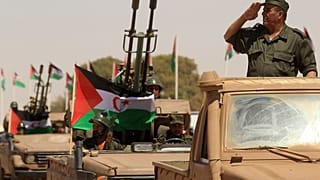
Many recently gathered to mark the 50th anniversary of the proclamation of the Sahrawi Arab Democratic Republicby the Polisario.
"We will never back down," said Hadjeb Bent Sid Ahmed Ouled Hamma, 76. "We will never give up on the independence of our country."

Abdelhadi El-Goueiri, a 29-year-old mining engineer, said he pursued his studies "to follow in the path of our fathers in the struggle for full independence and to free ourselves of colonialism."
Life in the camps is heavily dependent on humanitarian aid, with the refugees often facing shortages of food and water.
Many here express gratitude to Algeria for its support — from food supplies to schoolbooks and medicine — but say their aspirations lie across the border.
"If we could talk about international law, then it must be recognised that there is a people here and decades of struggle for a just cause," said Fatema Bent Khattery Sidi Abedi, a 56-year-old teacher.
She lamented the hardships endured in the camps, including long sandstorms during which "everything disappears under the dust" for days.
'Inalienable right'
Under neighbouring canvas tents, women spin wool while others grind seeds using traditional stone mills.
In another tent, children recite verses from the Quran, reading in unison from the chipped wooden tablets on which they transcribed them.
Further on, a wedding is in full swing, with music and dancing.
But even after decades of exile, the refugees cling to "an inalienable right to self-determination", said Ouali Ahmed Sidi Moulai, a 55-year-old trader, who described the conflict as "a matter of decolonisation."
Many countries including France, the United Kingdom and Spain have recognised Morocco's sovereignty over Western Sahara.
But the territory remains on the UN list of non-self-governing territories, while the Polisario still demands a UN referendum on self-determination, which was promised under a 1991 ceasefire but never held.
The Sahrawis meanwhile remain defiant.
"We will not accept at any rate (Morocco's) autonomy plan [...] whatever sacrifices are required and despite pressure from the international community," said Salima Bent Elghifri Ahmed, 75.
01:43
Moroccan voters call for action after election results
02:19
Tangier’s annual art night brings the city’s creative spirit to life
01:06
Ceuta migrant crisis: 28 undocumented migrants found hidden in Spanish flats
01:09
Morocco’s PAM leads parliamentary election with turnout at two-decade low
02:00
Morocco’s opposition leader casts vote in parliamentary election
01:22
South Sudan's election commission urges peaceful electoral process