



Niger
Niger’s military-led authorities said on Wednesday that they will take French uranium giant Orano to court, accusing the company of creating an “ecological disaster” in the country.
It claims the firm is storing 400 barrels of radioactive material at a site near Arlit in northern Niger, where Orano previously operated uranium mines.
Justice Minister Alio Daouda said this has endangered local communities and amounts to environmental damage and large-scale harm to public health.
He said Niger will take its case to national and foreign courts in order to obtain a conviction and reparations for the damage suffered.
Niamey’s decision to sue Orano is the latest twist in its ongoing battle with the nuclear group and the country’s former colonial ruler as part of a pivot away from Paris and towards allies like Russia.
After taking power in a 2023 coup, the junta revoked Orano’s licence for the Imouraren deposit and last year, nationalised its Somair subsidiary.
Somair operates the country’s only remaining operational uranium mine.
Orano, which is 90 per cent owned by the French state, has launched several legal proceedings of its own against Niger, accusing the junta confiscating its assets.
After nationalising Somair, the junta announced in November that it planned to sell uranium produced by the mines formerly run by the French company on the international market.
A few days later, Orano warned that a shipment of at least 1,000 tonnes of yellowcake, or concentrated uranium, had left the Arlit mine, previously split between the French group and the Nigerien state.
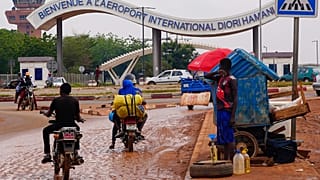
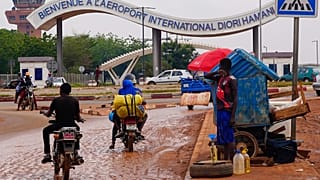
The radioactive cargo has been blocked for several weeks at Niamey airport, the scene of a jihadist attack on the night of 28 to 29January, claimed by the Islamic State group.
Orano has recently vowed to pursue its legal action against Niger, as well as "anyone who wishes to get their hands on the blocked uranium stockpile”, which it values at $354 million.
Uranium was first discovered in Niger in 1957, when the country was under French rule, with mining beginning in 1971.
The country produced 3,527 tonnes of the radioactive metal in 2023, equal to 6.3 per cent of global production, according to mining industry publication Globaldata.




01:13
Guinea-Bissau: opposition leaders refuse offer to join government
02:20
French-Nigerian artists team up to craft future hits
00:22
ECOWAS lifts all sanctions against Guinea
Go to video
Rwanda vs UK: The fallout from a scrapped migrant deal
Go to video
France intercepts suspected 'shadow fleet' tanker from Russia
01:11
Algerian senate urges review of law declaring French colonisation a crime