



Elections
Residents of Somalia’s capital voted Thursday in a controversial local election that marks the country’s first one-person, one-vote poll since 1969.
Analysts say it is a major departure from clan-based power-sharing negotiations.
The voting of local council members, to be conducted across Mogadishu’s 16 districts, has been organized by the country’s federal government but rejected by the opposition parties, which have called the election flawed and one-sided.
Somalia has for decades selected its local council members and parliamentarians through clan-based negotiations, and it is the leaders who later elect a president.
Since 2016, different administrations have promised to reintroduce one-person, one-vote elections, but insecurity and internal disputes between the government and the opposition have delayed their implementation.
This will be the first major voting exercise overseen by the country’s National Independent Electoral and Boundaries Commission, with up to 20 political parties fielding candidates.
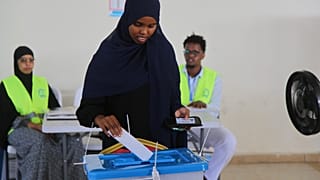
Voter Farhiyo Mohamed was excited to vote.
“Such an election happening before my own eyes and to take part in a universal election like this. As mothers, we are elated because we are an important section of the population,” she told The Associated Press.
The election will not determine the mayor of Mogadishu, who also serves as the governor of the central Banadir region.
That position remains appointed, as the constitutional status of the capital is unresolved and requires a national consensus — a prospect that has grown increasingly distant amid deepening political rifts between President Hassan Sheikh Mohamud and the leaders of the states of Jubaland and Puntland over constitutional reforms.
The central region has more than 900,000 voters registered across 523 polling stations, according to the electoral commission.
Somalia has faced security challenges, with the al-Qaeda-linked al-Shabab militant group often carrying out deadly attacks in the capital.
Security in the capital has intensified ahead of the local elections.
Analysts say the Mogadishu vote represents the most concrete attempt yet to move Somalia away from its longstanding clan-based, power-sharing system.
Go to video
UN Security Council agrees to extend African Union peacekeeping mission in Somalia for another year
01:14
CAR deploys armed forces and MINUSCA to secure elections
01:48
United States: Vermont school district receives threats after putting up Somali flag
01:04
Ethiopia to hold general election on 1 June 2026
01:00
Trump deportation push sparks clashes in Minneapolis
02:19
Somalia's poets keep hope alive for storytelling and for peace