



Sudan
The United Nations food agency said on Wednesday that its ongoing efforts to fight severe hunger in Sudan are beginning to show some encouraging results.
It said it was able to scale up aid distribution in 10 areas where famine was confirmed last year and that in 9 of them, the risk has now been declassified.
Despite promising signs, the World Food Programme said Sudan remains one of the world’s largest hunger crises, with famine confirmed in two parts of the country.
“That's in the Darfur states and in the Kordafan states in the south. One problem is access, and that is affecting particular towns such as the city of el-Fasher and Kadugli,” said its regional emergency coordinator, Shaun Hughes.
The other problem is one of resources.
“We're reaching four to five million people each month, but most of them are receiving reduced rations, and come January, we simply won't have the resources in the pipeline in order to be able to continue providing that level of assistance,” he said.
Sudan’s war began in April 2023 over a power struggle between the military and the Rapid Response Forces (RSF).
The conflict has killed more than 40,000 people, a figure rights groups consider a significant undercount, and has created a major humanitarian crisis, with more than 14 million people displaced.
However, since the beginning of 2025, the number of people receiving assistance in areas previously confirmed in famine, or at risk of famine, has tripled, the WFP said.
This is thanks the fact that it can access areas that were previously largely inaccessible, including the capital, Khartoum.
Hughe said the WFP is on the ground in Darfur where hundreds of thousands of people that have fled from al-Fashir and elsewhere in recent weeks.
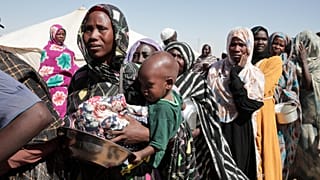
“We are responding to those people in the areas where they are arriving, for example there are more than half a million people that have arrived to Tawila,” he said.
Hughes said the agency was assisting people there and also in other towns around north Darfur and the northern states.
“So the response needs to be agile, it needs to be flexible, we need to be able to re-route our convoys and assistance according to a very dynamic and insecure situation on the ground.”
The agency says more than 21 million Sudanese are facing acute hunger. It adds that with increased funding and access it could help more people each month and support conditions for them to return home.






00:10
Somalia denies aid seizure as US suspends assistance over WFP warehouse claims
01:09
Trump orders US withdrawal from 66 international organisations under ‘America First’ policy
01:36
DRC, Liberia among five new non-permanent UN Security Council members
01:17
Israeli recognition of Somaliland is a 'calculated distraction,' Somali diplomat says
Go to video
Sudan train before facing Senegal in Africa Cup of Nations
01:40
UN Finds dire conditions on first visit to Sudan’s el-Fasher since its fall