



São Tomé and Príncipe
In São Tomé and Príncipe, a new generation of cocoa producers is at the forefront of restoring degraded ecosystems and enhancing sustainable cocoa production, with support from the Food and Agriculture Organization of the United Nations (FAO).
32-year-old Camila Varela De Carvalho treks to her farm every morning with a bucket and a harvesting tool fashioned from a wooden branch and sharpened edge.
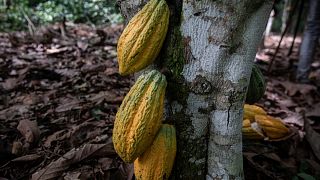
Once among the cocoa trees, she clears branches and skilfully picks ripe cocoa pods. Making small incisions, she splits the pods cleanly in two with a practiced twist, a skill honed from the early age of eight.
She scoops out the white pulp-covered cocoa beans, which, once dried and fermented, will be sold to become chocolates, providing the income that sustains her family and community.
Camila Varela De Carvalho said, "Cocoa makes a huge difference in my life because with cocoa money, I can get by when my husband isn't getting paid, or when I don't receive my monthly wage."
Camila is a mother of four. She also raises her four nephews. Her family relies on cocoa as the only stable source of income.
The granddaughter of contracted labourers from Cabo Verde, Camila followed her mother into the groves at a young age. She was raised with a motto: to be independent, a woman must master every task on the farm.
Camila Varela De Carvalho said, "I started working in agriculture when I was eight years old. I used to go with my mother to the plantation to harvest cocoa. She would harvest the pods with a stick, and we would gather them. I helped her break them open and carry them home. She always told me that a woman had to be able to do everything, from harvesting and breaking the pods to weeding the farm, because we could never wait for a man."
Located off the coast of West Africa, Sao Tome and Príncipe relies heavily on cocoa production to support local livelihoods. The island country faces increasing forest and land degradation due to agricultural expansion, changes in land use and the impacts of climate change. To address these challenges, FAO and the national government launched a project to restore forest ecosystems and enhance sustainable cocoa production as part of The Restoration Initiative (TRI).
A key partner in the Initiative is CECAB, the island's largest cooperative, which unites 37 producer groups and supports more than 2,000 families. Through improved agroforestry techniques and access to organic and fair-trade certifications, the Initiative helps farmers like Camila protect nature while strengthening their livelihoods.
De Carvalho said, "Before CECAB, we harvested cocoa, and tractors came to buy it. When the tractor was full, they almost didn't buy any cocoa. But now with CECAB, whenever you arrive, you can sell your cocoa."
By providing financial and technical support, the Initiative is empowering a new generation of farmers to lead the restoration of their own plots.
Since 20pe, more than 8,000 hectares of agroforestry in São Tomé and Príncipe eas have been restored. The goal is to reach 36 000 hectares, or one-third of the country, by 2030.
The project established nurseries to grow endemic fruit and other tree species, with over 240 980 seedlings now produced and planted in agroforestry plots on both the São Tomé and Príncipe islands. These trees provide critical shade for cocoa production, which relies on a healthy forest canopy.
Faustino Oliveira, FAO national project coordinator, said: "Knowing that these cooperatives operate in degraded agroforestry areas, the project's primary objective is to involve them by providing financial support to restore agricultural landscapes. This is because, in the recent past, these plots were subjected to widespread indiscriminate tree cutting."
In 2022 CECAB decided to expand from the production of raw cocoa and launched its own organic chocolate factory. This move toward high-value production was highlighted by CECAB's participation in the EuroChocolate 2024 fair held in Perugia, Italy.
Antonia dos Lantos Neto, manager of CECAB's chocolate factory, said, "The presence of this factory was a dream come true for CECAB producers. They have always produced and exported, but it is the first time Sao Tomean producers have their own factory, and they are transforming their own produce. It is a great satisfaction."
The project is also helping farmers like Camila look beyond the fields. After participating in the business classes provided by Initiativetive, she now dreams of moving from production to processing and transformation, making her own chocolate to secure her independence.
Camila Varela De Carvalho said, "I have a dream of making chocolate. I want to harvest my cocoa, dry it, and be able to make chocolate with my very own crop."
Funded by the Global Environment Facility (GEF) and in collaboration with the International Union for Conservation of Nature (IUCN) and the United Nations Environment Programme (UNEP), The Restoration Initiative (TRI) supports nine countries in their journey to restore ecosystems and degraded landscapes.
21 March is the International Day of Forests (IDF). Proclaimed by the United Nations General Assembly in 2012, the Day celebrates and raises awareness of the importance of all types of forest.
Thais Linhares Juvenal, FAO senior forestry officer, said: "Investing in forestry is a win-win solution for the world. Because we have a lot of supporting functions that are ensured, that are provided by a forest through its ecosystem services. So, for instance when we have agriculture close to forests, we need to spend less in fertilizers, pesticides, etcetera. The pollination services are essential for agricultural productivity. In addition to that we know that forests are an important factor to support the resilience of landscapes."
Under the theme of 'Forests and economies', IDF 2026 celebrates forests' essential roles in driving economic prosperity. From vital ecosystem services associated with water, climate and soils, to ecotourism, energy supply and raw materials, forests contribute trillions to the global economy and support millions of jobs worldwide.
![São Tomé and Príncipe : Ousted Prime Minister Takes Legal Action [Interview]](https://static.euronews.com/articles/stories/08/95/83/04/320x180_cmsv2_2b4ddc2e-c26f-5113-927e-34c0766d058f-8958304.jpg)


01:40
French Army initiates environmental protection training for African forces in Gabon
02:23
Community forest in Eastern DR Congo tests promise of local control amid conflict
02:09
War devastates Sudan's ancient acacia forest, threatening ecosystem
Go to video
Uganda’s export earnings nearly double in October on coffee and gold sales
00:14
Communities of slave descendants in Brazil demand recognition of territories and livelihood
Go to video
Ethiopian coffee exports earn more than $500 million in just two months