



Brazil
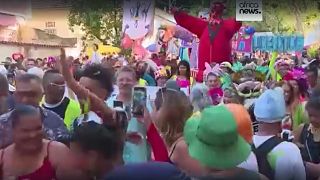
A traditional Afro-Brazilian festival filled the historic streets of Ouro Preto with music, dance and colour, as communities gathered to honour Our Lady of the Rosary, Saint Ifigenia, Saint Benedict, and Chico Rei—a legendary Congolese king enslaved by the Portuguese who later bought his freedom and became a symbol of resistance in Brazilian folklore.
Participants paraded through the colonial city singing and playing percussion instruments, blending Catholic devotion with African heritage in a celebration that dates back centuries. At the heart of the festival is the Reign of Our Lady of the Rosary, a tradition rooted in faith, identity and collective memory.
“It is this rebirth of the Kingdom, this strength that the Kingdom has been gaining more and more, providing joy, culture and faith to our entire city,” said Kedison Guimarães, Captain of the Mozambique Guard of Our Lady of the Rosary and Saint Ifigenia.
For many residents, the festival is also a deeply personal expression of heritage. “This festival, for me, represents the manifestation of an ancient, wonderful, ancestral culture that is, above all, alive,” said Cristina Simão, a retired resident of Ouro Preto.
The celebration has gained official recognition for its cultural significance. “Our Reign of Our Lady of the Rosary, Saint Ifigênia and Saint Benedict—the faith that sings and dances—is today an intangible cultural heritage of Ouro Preto and also of the state of Minas Gerais,” Guimarães added.
The festival stands as a powerful reminder of Afro-Brazilian resilience and the enduring legacy of African traditions in Brazil’s cultural landscape.








01:00
Brazil races to find survivors after deadly Minas Gerais floods
01:00
Pix of the Day, 25 February 2026
02:00
Floods kill 46 as mud and debris choke Brazilian towns in Minas Gerais State
01:00
Brazil landslides: 43 missing after heavy rain hits state of Minas Gerais
01:00
Georgia village revives Berikaoba, an ancient pagan spring festival
01:00
Pix of the Day February 17, 2026