



Senegal
For the Senegalese children who have lost a parent to the sea, navigating the burden of grief is not easy. When an adult has died trying to reach Europe, it is the children left behind who must rebuild their broken lives, often with fewer meals and greater poverty.
Many grow up too fast, forced to abandon school and burdened by the responsibility of earning money to help their family.
Known as "those who remain," their suffering is complicated by the taboo in speaking about their parents' decisions to leave.
Breaking this silence is the goal of a pioneering programme supported by the Senegalese chapter of the Diocesan Delegation of Migration (DDM), launched in 2024, to provide psychosocial support to these children.
Eleven-year-old Sokhna’s father, Assane, has been missing since his pirogue caught fire off the coast in 2022.
"One day, my father told my brother and me that he wanted to go to Spain and asked us what we thought. I said to him, ‘Dad, don’t go, don’t leave me alone, I only have you and Mum’,” she said.
At the time, her mother was in hospital, but her father went anyway, saying he would earn a lot of money so that he could look after them.
Sokhna said her mother is still overwhelmed with grief and finds it difficult to talk to her children about their father.
She explained that her mom does not "understand" her when she wants to bring up her father. Instead, Sokhna goes to her grandmother to hear stories about him.
Greater poverty
Her mother, Fatou Ngom, was only told that her husband was "among the victims" when the pirogue caught fire.
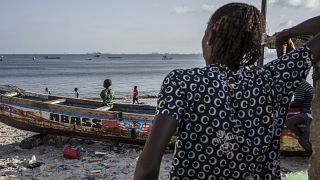
Now she and her three children are surviving with difficulty, living in a single room with a shared courtyard in the port city of Mbour**.**
Ngom explains that Sokhna is often distant, particularly in class, and has fallen behind in her schooling.
"Sometimes at night, she has dreams and cries out, ‘Papa, Papa, Papa’. When that happens, I’m afraid to stay in the bedroom," she said.
Unlike Sokhna, who appears to bury her sorrow, her 14-year-old brother Boubacar struggles to hold back his emotions while recounting the day in 2022 when he found out.
"My family came to find my mother, she was preparing coffee," he said. "They said 'Assane died in the pirogue'. She was in shock, she started crying, and so did we."
"I often think about him, especially when my mother doesn't have the money for daily expenses because he was the one who helped us live," he sobbed.
The teenager already works after school in a metalworking shop to help his mother.
The children left behind also have to deal with a sense of abandonment and sometimes anger at their parents decision to leave.
Families are also afraid to share the children's stories due to the authorities' often repressive approach, which includes arresting smugglers and "rescuing" boats whether or not they want to come back.
A fragile state of mind
Around 50 children who have lost parents are being supported by the DDM’s programme which began the project after noticing the suffering of wives of missing persons.
This, it observed, was particularly due to the uncertainty surrounding the type of death.
"We noticed that many of their children were also suffering, in a different way, more silently, with a great deal of anger," said DDM director, Jordi Balsells.
Apart from the work carried out at its Mbour base, the NGO conducts three other tours a year in other regions of Senegal and provides in-home support.
In its light-filled Mbour centre, children whose migrant fathers have disappeared receive therapy while their mothers work in a sewing workshop to supplement their income.
The children's horsing around often masks a fragile state of mind.
Babacar Ndiaye, 12, overwhelmed by emotion, was unable to confide in anyone about the disappearance of his father, a fishmonger, in 2024 when his pirogue capsized.
"Know that if you want to talk, we're here," Tesa Reimat Corbella, a doctor specialised in bereavement, gently told him.
In contrast, Babacar's nine-year-old brother, Pape Balla, is surprisingly confident. He opened up while clutching two figurines, a crocodile and a llama.
"My father didn't want to leave, but the person who organised the trip forced him," he said, his way of coping with an abandonment he cannot understand.
"It hurts me that he's gone, I wanted him to stay with us."
He has neighbourhood friends whose parents also died but do not want talk about it, he said, recalling how his father "often bought me balloons, I miss that."
Like Babacar, 10-year-old Bambi Diop could at first only manage to articulate a few words: "I don't want to talk about my father," she said.
Psychotherapist Katy Faye gently placed her hands on Bambi's shoulders and tried to soothe her as the child began weeping.
"When I go to class, I think about him," Bambi finally said, explaining that it was often her father who would drop her off at school.
The young girl remains partly in denial, telling journalists that her father lives in another city in Senegal and is doing "fine."
These words came as a surprise to her mother, who insists that her daughter knows her father died in a shipwreck in 2024.
'Breaking the silence'
For Corbella, the main challenge "is breaking the silence" around the disappearance.
"We need to start putting words to what happened, to be able to talk with the children about the memories of who their father was, and to work with the parent who remains," the doctor said.
She is heartened that the NGO has succeeded in creating a safe space where the children "can share their feelings with other children."
"The fact that they accept what happened and that they can speak about it without fear or shame is what matters most," she said.
However, she acknowledges that there is still a great deal of work to do: "When these children step outside this space, whether at school or in the street, they still face stigmatisation."
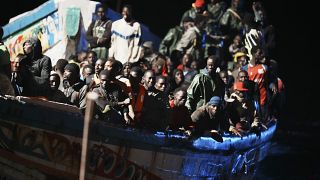
In 2024, at least 10,457 migrants died or disappeared while trying to reach Spain via the perilous Atlantic route, according to Caminando Fronteras, the highest number recorded since the organisation began counting in 2007.
Those fleeing Senegal are driven by despair and the lack of opportunity, with unemployment, a depleted fishing stock and other factors creating a dire situation.
In addition, Europe's restrictive visa policies and increased border patrols have caused migrants to resort to clandestine and rickety boats.
At the DDM centre, the late afternoon light cast a soothing glow as three children lined up on a mattress on the floor, captivated by an animated film.
Senegalese society must be made more "aware of the plight of the missing and their families," Corbella said, adding that "it is important to restore dignity to the missing — people who left in search of a better life."
"We must be able to speak about this subject without hiding these children and families."





01:39
Morocco and Spain boost security in Ceuta as another call for border rush seen online
01:00
Half a million visitors flock to Spain’s path of total solar eclipse
01:17
Moroccan authorities say they have beefed up security at Ceuta border
02:11
Spain prepares for rare total solar eclipse as 2026 sky show approaches
01:00
Spain’s Huelva blaze threatens homes, 800 evacuated amid severe drought
01:25
Argentina footballer Lionel Messi travels home to attend his father's funeral