



Cocoa
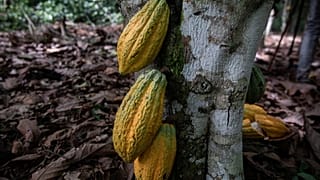
Sacks of dried cocoa beans sit unsold in homes and warehouses in the Ivorian village of Kouamé-Kouassikro, near Bouaflé, while farmers hold receipts instead of cash.
A sharp fall in cocoa prices over the past year has left beans rotting in some West African warehouses, while global chocolate makers scramble for supplies and consumers seek their fix.
Ivory Coast, the world’s leading cocoa producer, had to purchase an excess supply of cocoa beans from farmers in January and this week slashed the price by more than half for 2026.
Agricultural worker's unions in west Africa say some authorities were not prepared for a crash of this scale.
Hundreds of thousands of farmers in West Africa rely on cocoa farming for a living.
In Ivory Coast government regulators set a fixed price for the cocoa bean at the beginning of every planting season, and the majority of the beans are sold through government-licensed parties to protect farmers from price fluctuations on the international market.
In 2024, a surge in cocoa on international markets reached more than $12,000 per metric ton, the highest in decades. Then it crashed to around $4,000 as supply outstripped demand.
The downturn in price meant global traders would run at a loss if they purchased cocoa beans from the two African countries.
That led to a mounting stockpile of rotting cocoa beans in warehouses, while farmers who already sold their stocks to governments have not been paid for months.
Many hold pieces of paper which promise cash, but these "I owe yous" aren't being paid and the farmers find themselves in the position of having to plant another crop with money they don't have.
“They have been weighing the cocoa since November. To this day I still haven’t received the money, and I still have dried cocoa in my house. I can’t find anyone to buy it. Right now I don’t have money for work in the fields” says cocao farmer Simplice Konan Konan.
Government regulators set a fixed price for the cocoa bean at the beginning of every planting season, and the majority of the beans are sold through government-licensed parties to protect farmers from price fluctuations on the international market.
Late last year, Ivory Coast’s President Alassane Ouattara announced a farm-gate price of 2,800 CFA francs per kilogram for the main crop, a figure many farmers saw as a rare moment of stability after years of hardship.
However the 2024 surge in prices and the following crash has left them wondering what to do next.
Farmers say the reduction in price has left their profit margin very slim when they factor in the costs of production.
Célestin Kouassi Kouadio, chief of Kouamé-Kouassikro village says: “We are even tempted to abandon cocoa farming to plant cassava or cashew instead. That is also what we want to do. Because we earn nothing from coffee and cocoa, so it is better for us to do something else.”
He's not the only farmer pondering whether to abandon growing cocoa.
Some are even considering the desperate step of giving up part of their land to illegal sand miners. Sand is used in concrete and prices are driven by the high demand for construction.
The cost is severe, however: the sand mining makes the land infertile.
Many other farmers are finding other uses for their farms, including leasing them to illegal gold miners, according to the Ivorian cocoa farmers’ union.
In the cocoa storage room Diarra Bosh an official from National Agricultural Union for Progress in Côte d'Ivoire (SYNAPCI) says trade has just stopped.
“This is cocoa storage — there is no money. Since November and December, products that were sent to Abidjan — not even 5 CFA francs have been paid. People only have receipts. I will show you some receipts without money; I have two receipts with me. There is no money, nothing has been paid, and we are worried — will middlemen come and find this stock in our hands, and at what price will they buy it? Here are the receipts,” says Bosh.
Farmers believe there are structural issues with the way cocoa is traded, they say they missed out on benefiting from the original surge then the whiplash in prices made some decide enough was enough.
Marcelin N’Da is a researcher specialising in cocoa production at the National Polytechnic Institute Félix Houphouët-Boigny – INPHB.
He says reforms to the system are essential.
”At the operational level, for example, we propose reforming price-setting to create a price band system. This would allow producers to benefit from price increases, and when prices fall, the entire value chain would share the risks and consequences — so that the producer alone does not bear the impact of falling prices,” explains N’Da.
At a farmers meeting in Daloa Maître Kouassi, cooperative leader and jurist describes what is happening to many cocoa growers.
“Instead of payment, we were given receipts as promises of later payment. Those among us who did not wish to accept these famous receipts were offered a purchase price per kilogram of coffee below the official price. Or several kilograms were deducted from each sack for the benefit of the buyer. In total helplessness, this situation caused us harm.”
Governments in west Africa are racing to find solutions to this systemic failure.
Ghana has initiated efforts to loosen regulations on price controls, and in January slashed its fixed price for cocoa beans by 28% to 41,392 cedis ($3,881) per metric ton, in an attempt to make the beans more accessible to buyers.
This week, Ivory Coast also slashed the price paid to cocoa farmers by more than half to 1,200 CFA ($2.13) per kilogram ($0.97 per pound) for 2026.
Amadou Coulibaly the Minister of Communication and Government announced: "I remain convinced, knowing the commitment of the head of state to pay producers at least 60% of the pre-caf price, i.e., the international price. And that this commitment will be upheld once again, and we can consider that this will be a very serious remunerative price in all respects; at least, that is the commitment of the head of state.”
But farmers say the reduction in price has left their profit margin very slim when they factor in the costs of production.
Some say it will mean that a child will have to drop out of school.
Some cocoa producers elsewhere in the world — South America and Asia — have improved their supply but West Africa still makes up the bulk of production.




01:37
South Africa still battling FMD in cattle, mass vaccination campaign launched
02:12
Ivory Coast: women tap into financial freedom through rubber tree farms
11:17
Egypt: Tourism holds strong despite regional tensions [Business Africa]
01:46
Ivory Coast cocoa growers to face 60% price cut on their produce
01:09
Ghana's cocoa crisis deepens as buyers owe banks $750 Million
11:19
Can IFAD’s “First Mile” revolution secure Africa’s food future?{Business Africa}