



Organised crime
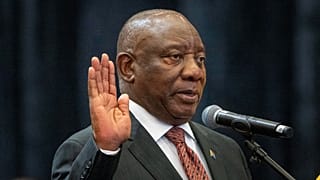
South Africa's president announced earlier this month that he will deploy the army to high-crime areas to fight the scourge of organized crime, gang violence and illegal mining.
President Cyril Ramaphosa said soldiers would take to the streets - in places that have some of the world's highest rates of violent crime - to combat what he described as the “most immediate threat” to South Africa’s democracy and economic development.
He said the deployment would happen in three of the country’s nine provinces, without giving a timeline.
Some critics, however, say the army deployment could be seen as an admission that Ramaphosa's government is losing the battle.
With a population of some 3.8 million, Cape Town is South Africa's second-largest city and one of its top tourist attractions.
But the neighborhoods on its outskirts, known as the Cape Flats, are notorious for deadly gang violence.
Street gangs with names such as the Americans, the Hard Livings and the Terrible Josters have for years battled for control of the illegal drug trade, while also being involved in extortion rackets, prostitution and contract killings.
Bystanders, including children, are often caught in the crossfire and killed in gang-related shootings.
According to the latest crime statistics, South Africa's three police precincts with the most serious crime rates are all in and around Cape Town.
"They’re hoping that the army will bring a little bit of peace," Craven Engel, the founder of Ceasefire, said of Cape Town's Hanover Park residents. "In fact even when we come in and we create solutions, even if it’s for one day, the community will start clapping hands because there’s a day without shooting.”
Ramaphosa said one part of the army would deploy in the Western Cape province, where Cape Town is located and which statistics say has around 90% of the country's gang-related killings.
Two other provinces, he said, would also see troop deployments - Gauteng, which is home to Johannesburg, South Africa’s biggest city, and the Eastern Cape province.
The outskirts of Johannesburg and the wider Gauteng province are dotted with abandoned mine shafts and authorities there have long grappled with illegal gold mining.
They say the mining gangs - known as zama zamas - are typically run by heavily armed crime syndicates, brutal in protecting their operations.
They use “informal miners” - recruited from desperate and impoverished communities - to go into the shafts, searching for leftover precious deposits.
These gangs are often connected to high-profile violence, including a 2022 case that shocked South Africa when around 80 alleged illegal miners were accused of gang raping eight women who were part of a music video shoot at an abandoned mine.
Last year, a standoff between police and illegal miners in an abandoned mine left at least 87 miners dead after police took a hard-line approach and cut off their food supplies in an attempt to force them out.
The illegal miners are often involved in other crimes in nearby communities, analysts say, and turf battles between rival gangs have forced people to leave their homes and seek safety elsewhere.
Authorities say there are an estimated 30,000 illegal miners in South Africa, operating in some of its 6,000 abandoned mine shafts.
The government has noted an increase in illegal mining, which it estimates is worth more than $4 billion a year in gold lost to criminal syndicates.
The trade is believed to be predominantly controlled by migrants from neighboring Lesotho, Zimbabwe, and Mozambique, stoking anger among South African communities against both the criminal bosses and foreigners living in the local community.


01:45
Life slowly returns to Port-au-Prince area after Haiti drives gangs out
01:06
South Africa's debt stabilises for first time in 17 years
01:51
11 South African men allegedly tricked into fighting in Ukraine return
01:29
Ramaphosa thanks Putin for release of South Africans fighting for Russia
00:58
Shootout in Port-au-Prince as police exchange fire with alleged kidnappers
01:17
South Sudan: UN Aid Chief sounds alarm on humanitarian situation