



Brazil
Traditionally relegated to dancing, women in Brazil are continuing to make inroads into the historically male-dominated percussion part of the famous Rio Carnival.
The nine days of festivities include a competition for the city’s top samba schools, and for the first time ever, the drum section of one of them will be led by a woman, Laísa Lima.
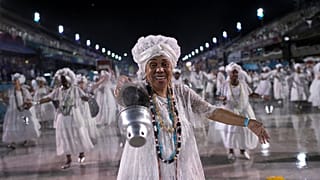
The spectacle in the Sambadrome brings together thousands from the city's samba schools to dance and beat out a rhythm.
"I don't know who started this business of saying that percussion instruments were not for women. Many drum sections banned women from participating. Fortunately that taboo was broken," says Laísa.
Her journey in samba began in her childhood. Her father was a legendary carnival designer and director.
By 16, she headed the tambourine section at Beija-Flor samba school and learned about percussion at Arranco, which she will lead in the Sambadrome on Saturday.
"Many people have that old belief that women are the weaker sex. However, the drum section is not about masculinity or strength. It's about feelings and about people management," she says.
A total of 15 schools will compete at the Sambadrome on Friday and Saturday, all vying for a place in the elite “Special Group”, made up of the top 12 schools.
There can be up to 4,000 participants in each school, all of whom must move in harmony to the rhythm of the drums.
"There are 250 in the drum section this year. Two hundred and fifty hearts beating in the same cadence, with the same purpose and conquering the same aim," says Laísa
At Arranco school around 30 per cent of the drummers are women, a high rate among samba schools.
The growth of women in percussion has been steady.
Thalita Santos, a drummer and drum conductor, has been working for decades to promote women in samba.
"Many women who dance learn to play. Many women who play learn to dance. Nowadays in carnival women can occupy any space, be it dancing or playing,” she says.
“It's no longer a division where women dance and men play. That's fortunately over. Now we are in the process of increasing the number of women playing."
Before reaching the main samba schools, many play at smaller neighbourhood groups, named "blocos".
Groups like Talita's exist in many areas of the city. Women are now a permanent presence in the drum section. And Saturday's parade will be another step forward.
The Rio carnival gets underway on Friday 13 and runs until 21 February.





02:20
The Amazons of African cinema triumph at the 4th edition of FIFF Cotonou
01:35
Foreign women linked to IS in Syria detention camps hope for amnesty
02:05
Singing contest in Rio prison offers creative outlet for women behind bars
02:34
Kenyan women's fight for their land rights after death of husbands
Go to video
Six African women break barriers in Forbes 2025 power list
Go to video
Nine women shot dead during protest in Nigeria