


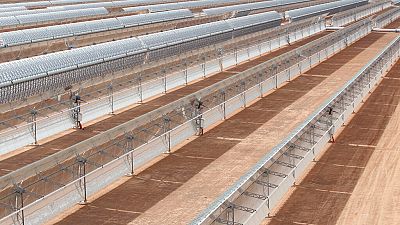

Morocco
The United Kingdom has withdrawn from a project to transmit power generated by North Africa's winds and sun via undersea cables and is turning to other projects considered less risky, British energy officials said Thursday.
The country's Department of Energy Security stated in a press release that it would no longer support the $33 billion project due to a "high level of inherent risk, related to both delivery and security ."
The Morocco-UK energy project was announced by the British company Xlinks in 2021 as part of an effort to create a global energy network and move energy from places where it is cheap to produce to markets with high demand. Xlinks said the project would supply the equivalent of 8% of Britain's current electricity needs, or around seven million homes.
"There are more robust alternative options that we should focus our attention on," British Minister Michael Schanks said in a statement, highlighting the inherent risk to taxpayers and consumers.
The UK relies heavily on natural gas for its energy needs and aims to produce all of its energy from renewable sources by 2030. It closed its last coal-fired power station last year and has offered partial funding to a range of wind, solar, and energy storage projects to help it reach its goal.
These large-scale infrastructure projects typically rely on government support or fixed prices per megawatt-hour. Xlinks has a fixed-price agreement and has already received loans from investors such as French company Total Energies and development bank Africa Finance Corporation .
Dave Lewis, chairman of Xlinks, said in a statement that the company would continue with its project despite the government's decision.
"We are extremely surprised and bitterly disappointed," he said, noting that the company believed its plan would provide electricity at lower rates and more quickly than other proposals, including the expansion of nuclear power .
Xlinks is one of a series of projects that reflect how European countries are looking to North Africa for clean energy, testing whether it is cheaper to produce renewable energy in ideal conditions, far from home, and then ship it, or to produce it in-country.
The project involves transmitting electricity via nearly 4,000 km of submarine cables protected by plastic and steel, with minimal transmission loss. If completed, it will be the largest interconnector of its kind, although smaller submarine cable networks already connect the UK to neighboring European countries.
In addition to Xlinks, transmission projects in Tunisia and Egypt aim to connect solar and wind farms to Italy and Greece.






01:50
Iran war fuels clean energy push but emissions remain high
00:51
Senegal inks deal with Italian energy giant Eni to study 5 offshore blocks
01:00
Robot valet parking at Gatwick Airport promises safer, easier long‑stay car storage
Go to video
Colossal energy brings veteran investor Warren Irwin on board as Africa strategy advances
00:56
Masked anti-immigration protesters disrupt UK's Dover port
00:56
Notting Hill Carnival kicks off in a burst of colour and Caribbean tradition