



Democratic Republic Of Congo
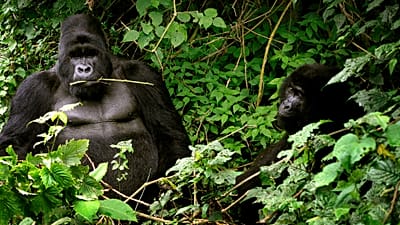
Mountain gorillas are some of man's closest living relatives
They share more than 98% of their DNA with humans.
But that similarity to man now also makes them vulnerable as the region tackles an outbreak of the deadly Ebola virus.
“We are in a very critical time of Ebola. It is one of the diseases we are concerned about that can spread between people and wildlife," says Gladys Kalema-Zikusoka, a veterinary doctor and gorilla conservationist.
Uganda's gorillas have never had Ebola, she says, but other populations in the region have been hit hard by the disease.
"Ebola has been happening in the western lowland gorillas, in Gabon and in the Republic of Congo - not DRC, Democratic Republic, but the neighbouring Congo Brazzaville, over 5,000 Gorillas have died of Ebola in the past 30 years," Kalema-Zikusoka adds.
While the Ministry of Health is working to contain this outbreak, which was first detected in Uganda in mid-May, conservationists are also trying to protect gorillas.
An NGO called Conservation Through Public Health has donated 25 non-contact infrared thermometers, 450 sets of rain gear and more than 30 smartphones to the Uganda Wildlife Authority (UWA).
The UWA says the gear will help protect gorillas and other wildlife from infected humans, while allowing tourists to continue to visit the primates.
“These are very, very critical equipment at this time because we are going to use them for surveillance of our animal health and visitors' health," says UWA executive director, James Musinguzi.
"We shall use the thermometer to take the temperatures, we shall of course, use the rain gear to make sure that the rangers, the guides and everybody who is working in the tropical forest of Bwindi are protected from rain and of course the phones are going to be used to capture data."
While preventing tourists from visiting the gorillas might seem like the safest way to ensure the animals don't contract Ebola, cutting off the flow of tourism money to the region poses an even greater risk.
Tourism means the gorillas and other wildlife have more value to the locals alive than dead.
"We need these people to come to pay money, which will stop people entering the forest to poach because during the pandemic, when tourism disappeared for 6 months, poaching really went up and that is when we lost Rafiki, a friendly silverback gorilla of the Nkuringo group. We don’t want to have any more losses during this outbreak,” says Kalema-Zikusoka.
The Africa CDC (Centre for Disease Control and Prevention) says that the current Ebola outbreak in Congo and Uganda has been the worst outbreak in history during its first month, with up to 35,000 suspected potential contacts.
With 894 confirmed cases and 204 deaths so far, the current outbreak is three times worse than a previous outbreak in Uganda in 2000 at the same point, according to the CDC. The number of cases is believed to be higher because the outbreak was confirmed on May 15, weeks after it was suspected to have begun.





01:41
Congo launches Ebola vaccination campaign for frontline workers
01:13
DRC: OCHA helps with response endeavours amid ebola outbreak
01:21
Medical teams in DRC face difficult conditions as the race to contain Ebola outbreak
01:44
Ebola treatment center welcomes community to visit in bid to build trust
01:49
WHO sees encouraging signs in Congo Ebola fight but warns of surging cases
01:55
African lab scientists gather in Togo to discuss challenges amid Ebola crisis