


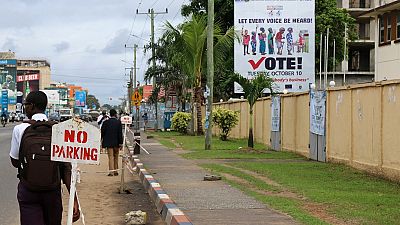

Liberia
Businesses in Liberia’s dual-currency economy are feeling the pinch as customers stay home.
The exchange rate also keeps climbing in the absence of a resolution to the country’s disputed presidential election.
“Nobody wants to buy, people are keeping their money,” said Ruth Wollie, one of many female market traders who make up an important voting bloc for Liberian politicians.
“For us to sell USD8 per day is very difficult,” she added at her stall in Monrovia.
Liberia has enjoyed 12 years of peace under President Ellen Johnson Sirleaf, but hopes for an economic revival after back-to-back civil wars between 1989 and 2003 were dashed by slumping commodity prices hitting key exports of iron ore and rubber, and the impact of the 2014-16 Ebola crisis which left some 4,800 people dead.
Now an electoral crisis has compounded the problem, with conditions becoming intolerable in a nation hugely reliant on informal trading for income.
It began in late October, when Vice President Joseph Boakai and opposition leader Charles Brumskine finished second and third in the October 10 election, but alleged “massive fraud” afterwards. Indubitable evidence
The allegations however were rejected by the National Elections Commission, which found the two parties failed to provide “indubitable evidence” as required by the constitution that the vote was tainted by fraud.
The parties then appealed to the Supreme Court, which is due to rule next week on whether to reject Boakai and Brumskine’s complaint and allow the runoff to go ahead, or call new polls. The process has delayed the selection of a Sirleaf successor for nearly a month, as Boakai was due to face top-placing candidate and former international footballer George Weah on November 7.
“We were expecting a run-off and they took themselves and carried themselves to court,” market trader Beatrice Harris said. “They were thinking it was for our (own) good, but it was not for our good – only for themselves.
“If they love us as Liberians, they will understand what it means to come to the market and can’t even find a meal for your child.” Christopher Pewee, a shoe seller in Paynesville, said the situation had “stagnated”.
“Investors are holding back investments, and the demand for US dollars is high. That’s why the rate has climbed from 110 to 130 Liberian dollars to the US dollar,” he said, surrounded by brightly coloured flip-flops. Liberia has two legal currencies: the Liberian dollar and the US dollar.
¨
AFP

00:53
South Sudan: Kiir opens political dialogue ahead of December elections
01:15
Cape Verde's President Neves to run for re-election in November
02:13
Nigerian presidential hopeful Obi promises anti-corruption drive
01:06
São Tomé and Príncipe President Carlos Vila Nova sworn in for second term
01:52
Liberia’s rescued chimpanzees receive health checks
Go to video
Zambia's Hichilema sworn in for a second term, Mundubile in jail