



Western Sahara
Morocco says it remains committed to the ceasefire in Western Sahara even in the absence United Nations peacekeepers.
Last week, the UN Security Council failed to agree on an extension of the 35-year-old mission after the US and Russia each vetoed competing resolutions.
In a statement on Wednesday, Morocco’s Royal Palace said the country’s “voluntary commitment" to the ceasefire wouldn’t change. King Mohammed VI ordered officials to protect Morocco’s territorial integrity, national security and residents.
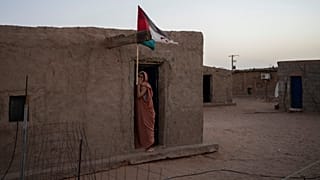
Mineral-rich Western Sahara is claimed by both Morocco and the pro-independence Polisario Front, backed by Algeria. Peacekeepers were deployed in 1988 to monitor a referendum that never took place.
Rabat welcomed the end of the UN Mission but Algeria expressed “deep regret.” The Polisario said it was “concerned.”
UN Secretary General Antonio Guterres also warned of a risk of escalation and urged all parties to exercise restraint.
Territorial dispute
The UN classifies Western Sahara as a “non-self-governing territory,” while critics of Morocco’s control describe it as Africa’s last colony. Morocco administers nearly all of the disputed territory, except for a narrow strip known as the “free zone” that lies east of a Moroccan-built sand wall.
After Morocco annexed it in 1975, the dispute escalated into an armed conflict that lasted more than 15 years and claimed more than 16,000 lives on both sides, according to the French Senate.
Bringing Western Sahara under its full sovereignty has been a central objective of Morocco’s foreign policy for decades. Rabat, which has secured the backing of a growing number of Western capitals, including Washington, Paris and London, refers to the territory as its southern provinces. The dispute has become a defining feature of Morocco’s diplomacy, with the kingdom often measuring its relations with other countries by their position on the issue.
The Polisario Front seeks independence for the territory, which it considers the homeland of the Indigenous Sahrawi people. Operating from refugee camps in the Algerian city of Tindouf, the movement aims to establish an independent Sahrawi Republic. Mainly backed by Algeria, Russia and South Africa, the Polisario has seen its international support dwindle in recent years.



01:52
WHO approves clinical trials on two new Ebola vaccines
01:32
UNESCO warns that most crimes against journalists go unpunished
00:55
China excludes La Liga matches from broadcast schedule after Mbappé’s Mao remarks
02:39
Africa is suffering in an era of strongmen, says Mo Ibrahim
01:50
Migrants find shelter in Cyprus as EU slows admissions
01:03
Drone strikes in Ethiopia kill at least 25: witnesses