



Democratic Republic Of Congo
The Democratic Republic of Congo said Friday it had "accepted the principle of a ceasefire" involving a "strict and immediate" freeze of positions in the conflict in the east of the country.
It did not give a date for when it would take effect, but the announcement comes after mediator Angola called on the Congolese government and the Rwanda-backed M23 armed group to respect a ceasefire starting on February 18.
The resource-rich eastern DRC has been mired in unabated violence between scores of armed groups for 30 years.
Angola in recent weeks has resumed its mediation efforts and released during Wednesday night a ceasefire proposal, which had yet to be approved by the warring sides.
The M23 militia has not so far officially responded.
It follows the announcement last week that the United Nations would soon send peacekeepers to the eastern DRC to help enforce any ceasefire.
The region, which borders Rwanda and Burundi, has been targeted by the M23 since the anti-governmental group's resurgence in 2021.
Since then, half a dozen ceasefires and truces have been signed and broken.
Violence sharply escalated when M23 fighters seized the North Kivu provincial capital of Goma in January last year as part of a lightning offensive across the country's east that left thousands dead.
Bukavu, the capital of South Kivu province, fell the following month.
Peace efforts led by Qatar and the United States have recently sought to end the crisis, leading to the signing of two separate accords.
Qatar has been mediating between the Congolese government and the M23 for several months, and a commitment towards a ceasefire was signed in July.
In a parallel effort, the DRC and Rwanda formalised a US-brokered peace deal in December in Washington.
However, the agreements have not so far succeeded in stopping the violence on the ground.
"The president of the republic has accepted the principle of a ceasefire," the presidency of the DRC said in a statement on Friday.
End military reinforcement
For the first time since the start of the peace talks, the Congolese government openly set out a framework for the implementation of a ceasefire.
It called for the "strict and immediate freezing of positions", as well as an end to any military reinforcement and the cessation of any rotation or offensive resupplying.
It also calls for an "end to all external support to armed groups operating on national territory".
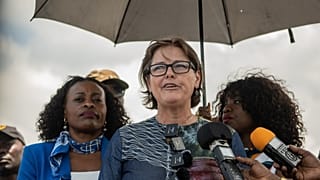
On Thursday, the acting head of the UN mission in the DRC landed by helicopter at Goma airport, which had been closed since the city fell to the M23.
The UN will deploy a first air reconnaissance mission in the city of Uvira in the coming days, Vivian van de Perre told reporters.
Uvira, which sits on the Burundian border, was seized by the M23 in December before its fighters withdrew under pressure from the United States.
The UN mission, MONUSCO, has around 7,000 UN peacekeepers in the eastern DRC. The closest base to Uvira is in Goma.
The African Union, which is now steering the peace talks, appointed Togolese leader Faure Gnassingbe to lead the mediation. He, in turn, has included Angolan President Joao Lourenco in the negotiations.
In late 2024, a previous mediation effort led by the Angolan president at the AU's request collapsed before a scheduled summit in Luanda, which was meant to bring together the Congolese and Rwandan presidents.


01:40
DRC: Acting head of UN mission touches down in Goma
02:09
Kagame criticises international "threats" against Rwanda as US sanctions loom
00:54
AFC/M23 rebels claim responsability for drone attack on Kisangani airport
00:51
DR Congo: authorities call for calm after drone attacks on airport
01:14
UN to deploy ceasefire monitoring mission to eastern DR Congo
Go to video
Families mourn victims of Congo mine collapse as search for survivors continues