



Zimbabwe
Zimbabwe has some of the deadliest roads in the world, with an average of five people killed in accidents every day. Now authorities are trying to take the problem in hand.
When Tafara Muvhevhi, a Zimbabwean driving instructor, began work 16 years ago, his job was simple: teach the highway code and prepare learners to ace their driving test.
Today, his priorities have changed. His main concern is no longer just the exam, but whether his students will survive some of the world’s deadliest roads.
This is vital in a country where road crashes rank among the top killers, according to the national statistics agency, and road accident fatality rates are among the continent's worst.
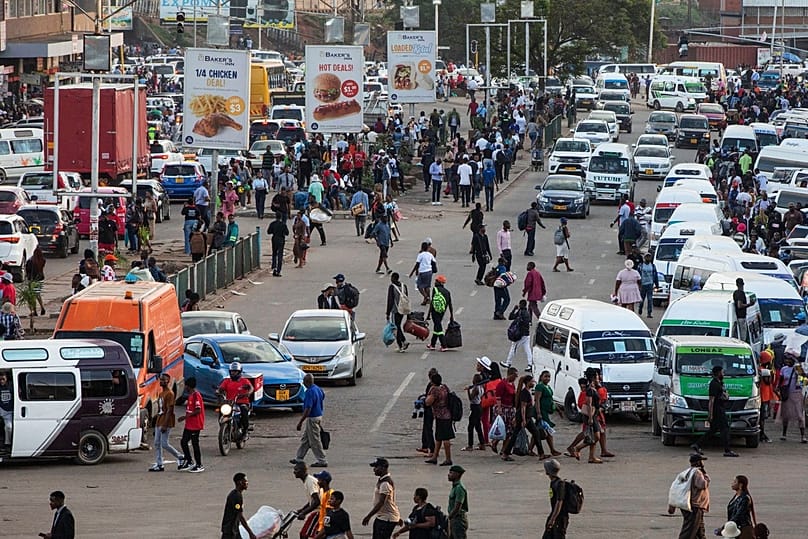
In Zimbabwe, a crash hits every 15 minutes and five die and 38 are injured each day, according to the country's traffic safety agency.
“Back then we were teaching by the book, it was all by the book,” Muvhevhi said while coaching his latest student through parallel parking and smooth reversing into spaces marked by blue drums on a dusty and worn-out tarmac training ground on the outskirts of the capital, Harare.
Traffic chaos
Once known for orderly traffic and well-kept roads, Zimbabwe's road safety steadily has deteriorated since the 2000s, degenerating into traffic chaos in the 2010s as economic decline gutted road maintenance, informal public transport boomed and enforcement weakened. Despite renewed repairs and policing efforts, dangerous driving remains deeply entrenched.
"The other drivers are no longer patient with us, they hoot, they overtake illegally, putting pressure on the students so our students are basically trying to adjust,” he said, before his student navigated through streets where both drivers and pedestrians have little regard for rules.
For the student, 19-year-old Winfrida Chipashu, a university accounting major, the roads of Harare are more intimidating than balancing ledgers.
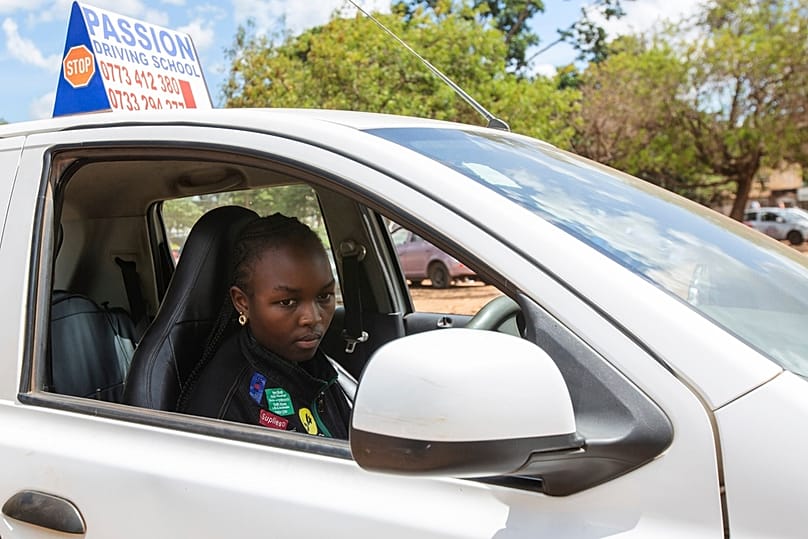
“You cannot really compare it to accounting because (in accounting) you have all the concepts," Chipashu said. “When you are driving in the jungle, you are confused by other people who are not following the road rules.”
The southern African nation’s roads turn most lethal during festive seasons and other holidays, but peril lurks daily, driven largely by dangerous driving that the government says is of alarming concern.
Human error
Zimbabwe has one of Africa’s highest road accident fatality rates, with the World Health Organization estimating nearly 30 deaths per 100,000 people.
On the roads, the contradictions are stark. Minibus taxis bearing “safety first” signs swerve wildly into pedestrian lanes and oncoming traffic. Fare collectors hang off doors and the back of moving vehicles shouting for customers. Sedans jammed with 12 passengers, including in the trunk, defy five-seat limits.
Authorities say 94 percent of road accidents in the country of 15 million people are caused by human error. Cellphone distractions among drivers and pedestrians cause about 10 percent of deaths, said Munesu Munodawafa, head of the Traffic Safety Council of Zimbabwe.
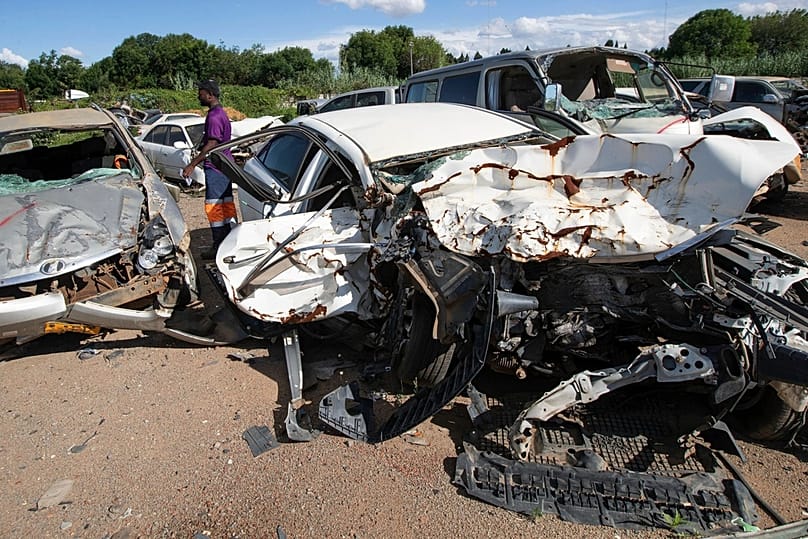
“For such a small population, those numbers are alarming,” said Munodawafa.
To increase road safety, police in Zimbabwe have recently acquired body cameras and breathalysers and are pushing for a review of the driver licensing system, including docking points for offenders and a revamp of driver training programs to highlight the dangers of reckless driving.




02:25
Zimbabwe’s inventive Valentine’s: Cash bouquets and scrap metal hearts
02:13
Families bid farewell to schoolchildren in South Africa killed in a school bus crash
00:56
Road collision involving fuel tanker causes huge fire in Nairobi
01:21
13 schoolchildren killed in tragic road crash south of Johannesburg
00:28
South Africa declares national disaster over floods and rains that have killed 30 people
01:00
Another crane collapse near Bangkok raises safety concerns in Thailand