



USA
U.S. President Donald Trump on Thursday praised the leaders of the Democratic Republic of Congo and Rwanda for what he called their “courage” in signing a new agreement aimed at ending the long-running conflict in eastern Congo and opening the region’s critical mineral resources to the United States and American companies.
The signing ceremony, held in Washington, offered Trump another opportunity to cast himself as a global dealmaker. The U.S. president, who has repeatedly expressed his desire to receive the Nobel Peace Prize, framed the pact as a diplomatic triumph.
“It’s a great day for Africa, a great day for the world,” Trump declared, adding, “Today, we’re succeeding where so many others have failed.”
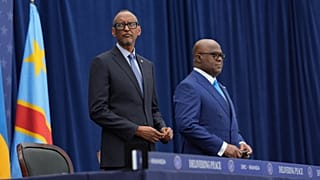
Presidents Félix Tshisekedi of Congo and Paul Kagame of Rwanda traveled to the U.S. capital for the signing, where they were joined by officials from other African nations. The ceremony came during the same week Trump publicly derided Somalia, saying he did not want immigrants from the East African country entering the United States.
The White House described the agreement as “historic,” building on months of mediation involving the U.S., the African Union and Qatar, and formalizing an earlier framework reached in June.
A Fragile Path to Peace
Despite celebratory language from Washington, the peace remains fragile. Eastern Congo has endured nearly three decades of conflict, with more than 100 armed groups operating in the region. The most powerful among them is the Rwanda-backed M23 rebel movement, which this year captured the major cities of Goma and Bukavu, displacing millions and worsening one of the world’s largest humanitarian crises.
Clashes continued this week, even as leaders signed the deal.
“We are still at war,” said Amani Chibalonza Edith, a 32-year-old resident of Goma. “There can be no peace as long as the front lines remain active.”
Still, both Kagame and Tshisekedi voiced cautious optimism.
“No one was asking President Trump to take up this task… but when he saw the opportunity to contribute to peace, he immediately took it,” Kagame said.
Tshisekedi acknowledged the challenges ahead. “This day is the beginning of a new path — a demanding path, indeed quite difficult. But this is a path where peace will not just be a wish, an aspiration, but a turning point,” he said.
Analysts cautioned that Thursday’s pact is unlikely to bring an immediate end to fighting. A separate agreement between Congo and M23 remains unimplemented on the ground.
Critical Minerals at the Heart of the Deal
The new agreement also builds on a recent economic framework among Congo, Rwanda, and regional partners. Trump announced that the U.S. had signed bilateral accords with both Congo and Rwanda to expand American access to critical minerals — a key strategic interest as Washington seeks to reduce dependence on China.
“We’ll be sending some of our biggest and greatest U.S. companies over to the two countries,” Trump said. “Everybody’s going to make a lot of money.”
Eastern Congo is home to some of the world’s richest deposits of cobalt, coltan, and other rare earths essential for manufacturing smartphones, electric vehicles, fighter jets and advanced technology. China currently dominates the global supply chain, accounting for nearly 70% of rare earth mining and 90% of processing.
Later on Thursday, American business leaders were set to meet Congolese and Rwandan officials to discuss investment opportunities in minerals, energy and tourism.
Conflict Still Rages on the Ground
While diplomats met in Washington, residents in eastern Congo reported new clashes in several areas. Both the Congolese army and M23 accused each other of violating a ceasefire agreed earlier this year. Fighting has also expanded across South Kivu’s central plateaus.
Conditions in rebel-held areas continue deteriorating. In Goma, the region’s former humanitarian hub, the airport is closed, banks remain shut, and crime and food prices have surged. U.S. funding cuts have further strained aid operations.
“We are waiting to see what will happen,” said Moise Bauma, a 27-year-old university student in rebel-held Bukavu. “So far, both sides continue to clash and attack each other.”
Congolese and Rwandan officials, however, maintain that U.S. engagement will be essential to any long-term solution.
“We need that attention from the administration to continue,” said Congolese spokesperson Gisèle Makolo. “We are under no illusion that this is going to be easy. This is not the end, but it’s a good step.”
Roots of the Conflict
The crisis in eastern Congo traces back to the aftermath of Rwanda’s 1994 genocide, after which nearly 2 million Hutu refugees fled into Congo. Rwanda accuses some Hutu militias of participating in the genocide and alleges that elements within the Congolese army have offered them protection.
Congo insists that lasting peace is impossible unless Rwanda withdraws its support for the M23 rebels — allegations repeatedly denied by Kigali, which says its actions are aimed at protecting its borders. U.N. investigators, however, estimate between 3,000 and 4,000 Rwandan troops are operating in eastern Congo alongside M23.


01:12
Qatar shuts down two energy facilities after being damaged in Iranian strikes
01:24
France to deploy aircraft carrier to Mediterranean to protect shipping
01:12
Trump says Iran war could last weeks, US citizens in dozens of countries urged to leave
00:57
Oil prices surge as Iran vows to attack ships in Strait of Hormuz
00:57
Tensions escalate as ships attacked in the Strait of Hormuz
02:19
Goma's iconic Amani Festival relocates to Lubumbashi