



famine
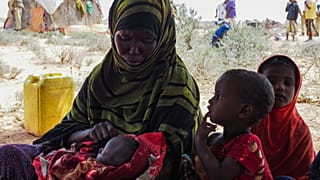
For three days, Halima Abdullahi Ibrahim carried her 3-year-old daughter from their village in Somalia to a hospital nearly 90 kilometres away.
The girl's body was swelling, and she needed medical help unavailable closer to home.
When she finally reached Kismayo Referral Hospital, Halima's daughter, Asho Hassan Abdi, was taken to the stabilisation centre, a white-walled ward lined with metal-framed beds, some beneath mosquito nets.
"My daughter developed Edema because of malnutrition," said Halima, holding Asho on her lap.
Ali Adan Ali, Jubbaland’s commissioner for refugees and internally displaced people, said many displaced families had received no humanitarian assistance since 2023 due to a lack of funding among aid organisations.
“The current situation of the IDPs in Jubbaland is very dire,” Ali said.
Meanwhile, Sandra Lattouf, Somalia representative for the U.N. children’s agency UNICEF, said children are dying from malnutrition, while illnesses including measles intensify the danger.
“We need to do more for them,” Lattouf told AP during a visit to Kismayo and called for closer cooperation among community health workers, local leaders, government authorities and humanitarian organisations.
Some 1.92 million Somali children between the ages of 6 months and almost 5 years old are suffering from or are expected to suffer from acute malnutrition and need treatment over the year ending in June 2027, according to an analysis by the Integrated Food Security Phase Classification.
That includes 433,000 children expected to suffer severe acute malnutrition, the form carrying the greatest risk of death.
More than half of Somalia’s projected malnutrition cases are concentrated in the south, where communities face disease outbreaks, food insecurity and limited access to health services, clean water and sanitation.
Expected El Niño-related flooding could displace more families and make those services even harder to reach.
The crisis comes as humanitarian organisations have fewer resources to respond.


02:16
Madagascar residents gear up for impact of El Niño
01:35
Thousands forced to flee as Houthis advance on Bab el-Mandeb Strait
01:02
Aid cuts leave millions of Somali children facing hunger
02:13
Nigeria's rescued kidnap victims face physical and psychological toll
02:21
Rescued kidnap victims in Nigeria recount ordeal during 6 months of captivity
01:48
Agency says over 40 per cent of Sudanese face acute food insecurity