



Nigeria
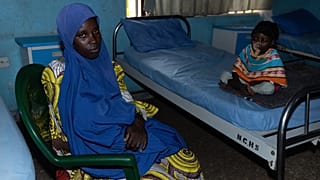
Frail and malnourished children and women lay on rows of hospital beds, their bodies bearing the scars of six months of captivity deep in the Nigerian bush.
The patients were among 163 kidnapping victims rescued earlier this month in the Kainji Lake National Park forest, after their village, Woro, was attacked by suspected jihadists.
In total, 308 people were freed in what the government called the largest single day rescue operation.
But at the Kwara State University Teaching Hospital in Ilorin, a long road to recovery lay ahead as victims deal with both the physical and psychological trauma.
A child lay beneath a blue sheet, hooked to a respirator, with doctors and nurses clustered around the bed. A sobbing girl, no more than six years old, sat alone on a bed, her family yet to visit.
"They are all responding to treatments," a nurse said, holding the tiny hand of a young boy about four years old. "Some of them still need blood."
Suspected jihadists attacked Woro, near the border with Benin, in February, killing at least 165 people and kidnapping scores.
Abductions have become a key moneymaker for criminal groups in Nigeria, especially among jihadists and non-ideological bandit groups across the north and centre of the country.
The victims were kept at a camp along with more than 100 others seized from other villages, including Kasuwan Daji and Konkoso, both in Niger state.
Dr Ahmed Bola Abdulkadir, Chief Medical Director of the Kwara State University Teaching Hospital, said most of them have severe malnutrition.
"Severe malnutrition with a lot of skin diseases. And quite a number had some fractures, just about one or two had some fractures," he said.
Some of the victims have described the harsh conditions they endured during the six months they were held in captivity.
Survivors have spoken of severe hunger, beatings, having to bury those who had died, and women giving birth in the forest without access to medical care.
“Some babies were born in the bush. In fact, we had some - I think one or two - that delivered a day or two before they were rescued,” said Abdulkadir.
Most were put into the hospital’s intensive care unit when they first arrived.
"All these issues go along also with some psychological trauma, which our psychiatrists have also seen most of them,” said Abdulkadir.
"We thank God we are out," one gaunt victim, Hajara, said. "I do not wish that on even my enemies. It was like we just came back from hellfire."
Mass abductions and kidnappings for ransom are a major security issue in Nigeria, which has been battling a jihadist insurgency centred in the north-east since 2009.
They have also been expanding into the north-west, which is already facing a separate, overlapping crisis from armed "bandit" gangs.


00:46
Ethiopia, Djibouti, and Dangote to build $660m petroleum pipeline
11:19
Dangote’s Big Energy Expansion: From Nigerian Refinery to African Powerhouse {Business Africa}
02:03
Nigeria appoints panel to probe deaths of 37 miners in holding cell
02:06
Nigeria gold miner deaths spark protests in Niger state
01:41
Nigeria probes deaths of 37 suspected illegal miners in custody
00:39
Nigeria: Armed security deployed in Minna after deaths of miners