



Ebola virus
Traders are facing big losses after Uganda closed its border with the Democratic Republic of the Congo over Ebola contagion fears.
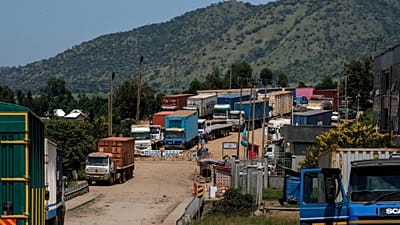
Leah Masika was on the verge of tears as she thought of her valuable consignment of plantain stuck in a long convoy of trucks on both sides of the Uganda-Congo border on Thursday.
Her cargo, destined for Uganda, was starting to leak water, and would go bad within hours if there was no movement.
The Ugandan trader was awaiting clearance from authorities for trucks to pass through the Mpondwe border post on Thursday after they were prevented from entering or leaving Uganda as part of escalating measures to prevent cross-border Ebola contagion.
“All our goods are now there rotting,” she said.
On May 28, about two weeks after Congo declared an outbreak of Ebola in the eastern Ituri province, Uganda closed its western border in a decision that reflected growing fears of cross-border contagion.
Exceptions were made only in emergency cases, including for the outbreak response, humanitarian, cargo or security reasons.
But in recent days, as the spread of Ebola in eastern Congo appeared to outpace the response, authorities in the Ugandan frontier district of Kasese have tightened the measures.
Traders said they are frustrated by the slow movement of cargo trucks.
The Uganda-Congo border, several hundred miles long and crossed by numerous footpaths, has been beyond formal border posts.
Mpondwe was Uganda's top border post for informal exports that were valued at an estimated $131 million in 2023, according to the Uganda Bureau of Statistics.
After the recent border closure, some shops were shuttered and young men, deprived of casual work, sat on stools dolefully.
“Ebola has destroyed our work,” said Ismail Mumbere, who often worked as a vendor of roadside snacks on the Ugandan side.
"We were told that trucks would go through but people were barred from crossing, but now even cargo trucks are blocked.”
The current outbreak in Congo is suspected to have infected over 1,000 people.
The number of confirmed cases has been much lower because many suspected victims succumb to their symptoms outside hospitals and without firm proof they had Ebola.
The World Health Organization, while declaring the current outbreak a public health emergency of international concern, discouraged border closures.
But the U.N. agency also acknowledged that neighboring countries are at high risk of contagion.
"The border on Mpondwe has porous points about 32 just across, across the board,” said Arafat Bwambale, a surveillance officer for Kasese, defending the measures.
Officials were trying to stop Congolese nationals from crossing to Uganda by way of more than two dozen footpaths along the Mpondwe border, he said.
All available vaccines and treatments for Ebola haven't worked for patients with the rare Bundibugyo type spreading in Congo, making the outbreak worrisome.
Uganda has confirmed 15 Ebola cases, all linked to the outbreak in the neighboring country after some Congolese nationals sought treatment in the Ugandan capital of Kampala before it was known there was an outbreak.
The disease was believed to have been spreading for days or weeks before the outbreak was declared on May 15.
Uganda has had multiple Ebola outbreaks of its own since 2000, when the disease killed more than 200 people.
Ebola, named for a tributary of the Congo River, was first discovered in 1976 in simultaneous outbreaks in Congo and present-day South Sudan.
Outbreaks are believed to start with the virus spilling over into humans from an infected animal such as a fruit bat. These cross-species infections often happen when people handle and eat wild meat, according to experts.
Once Ebola has infected one person, the virus then spreads through close contact with sick or deceased patients’ bodily fluids, such as sweat, blood, feces or vomit.
Tracing and isolating contacts was seen as key to stopping the spread of Ebola, in addition to getting medical workers proper protective equipment.
Bwambale, the surveillance officer, said the nearest referral hospital in Kasese has an isolation center and is equipped with a lab that can return results on a sample within six hours.
In recent days, samples taken from 41 people in the Kasese area tested negative for Ebola, which manifests as hemorrhagic fever.
Still, authorities appeared to be planning more restrictions.
A meeting of the local Ebola task force was likely to come up with “a more restricted way on how both the cargo or the trucks get into the country in a systematic way,” Bwambale said.
That alarmed traders for whom the Mpondwe border post has become the primary route of business.
Masika, the plantain dealer, said she would not order more goods from Congo until the current outbreak was over.
But she would be in trouble if the cargo already in transit didn’t reach various locations in and around Kampala, where the fruits, deep fried or boiled, are a staple of breakfast menus in restaurants.
She said she couldn’t countenance a loss of 50 bags, each worth roughly $44.
“We are begging them to help us and open [the border],” she said. “We will not go back to Congo.”


01:41
Clinic in DR Congo's Ebola epicenter 'overwhelmed' with patients
02:09
Rumors and mistrust persist over Ebola outbreak
02:06
Kenya’s president again defends US Ebola facility decision
01:23
Residents of Kenyan town hosting U.S. Ebola center oppose facility
Go to video
Traditional healers in DRC say they can cure Ebola
01:06
Ebola: Controversial U.S.-backed quarantine center in Kenya starts