



Uganda
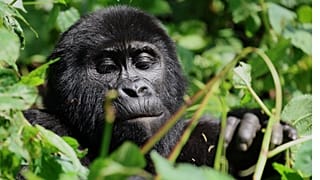
These gentle giants live amongst the lush-green trees of the Bwindi Impenetrable National Park, in south-western Uganda. The UNESCO World Heritage site is home to about 450 mountain gorillas—almost half of the world’s remaining population of these endangered great apes.
Their numbers have increased in recent years.
Tourism has become central to conservation efforts, with money from visitors funding local communities and creating new incentives to protect the animals.
Many groups of habituated gorillas in the park have become comfortable in the presence of humans.
Tourists pay a considerable sum — $800 in permit fees per foreign non-resident — for the right to see gorillas in their natural habitat.
However, deforestation around the edges of the park remains a problem, creating biodiversity loss within the ecosystem and a debate about access to forest resources.
Habitat encroachment and poaching are in decline as wildlife authorities collaborate more with nearby communities.
The Uganda Wildlife Authority (UWA) has been working to improve relations with local communities and reduce tree loss for medicinal purposes, firewood and raw materials for crafts.
“We are looking at this as also curbing encroachment activities. Whereas some communities can ask for herbal medicine from the park, the park is looking at how we can provide these tree seedlings be provided to the communities so that they get them when they have not entered the park”, explains Joseph Muhindo, an assistant tourism and hospitality officer for the Uganda Wildlife Authority.
“They bring several tree species that are medicinal to the community so that they can harvest from within the community without tampering with the habitat for the gorillas that is highly respected, and being an endangered species that made us attain the title of being a World Heritage Site”, he adds.
Christina Katushabe, who founded a local community-based organisation in the Bwindi Impenetrable Forest called Change a Life, is working with a project that donates trees considered to be valuable by local people, to those communities living outside the park, therefore reducing pressure on the forest.
“Being a neighbour to the park, I understand that the number of gorillas is increasing, but the forest habitat is not increasing. Adding a small part of a forest or an indigenous forest improves the biodiversity of Bwindi National Park and the forest range, and this contributes to habitat and also food for wildlife and the mountain gorillas, who are our neighbours”, says Katushabe.
Helping people access trees normally only found in the forest helps protect the gorillas, adds Katushabe.
“My love for nature has mostly been inspired by the Indigenous people that I work with, who are the Batwa people. Seeing the fact that they have guided us to do the right thing, that is the selection of the right trees to plant, selection of the most-needed trees that we need as a community, that is both for medicine, for timber, for firewood, but most importantly to support the ecological work that we are doing and also improve the biodiversity of the forest”, she says
Interest in protecting mountain gorillas is a consequence of the economic benefits of tourism.
These women make products from natural resources that they sell to visitors.
“Some time ago, they brought us ‘Amakwatangwe,’ (grey goosefoot) and eucalyptus trees. We planted them near the park so that we people and the gorillas do not inconvenience each other”, says Owembabazi Eunice who is part of a women group that makes local crafts and selld to tourists.
Katushabe has now spread her campaign to schools, teaching young people about tree planting which gives them practical knowledge about environmental conservation that they can pass on to future generations.
“We are going to protect the forest, so that our gorillas can stay well, now we are going to get [the benefits of the trees] up close to us. That is why we have planted these trees, to stop us from cutting the forest”, says 20-year-old Davis who is a student at Ruhija Seed Secondary School, a school located at the boundaries of the Bwindi Impenetrable Forest.
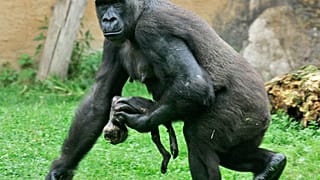
The outlook for mountain gorillas has been positive since 2018, when a survey showed that the population exceeded 1,000.
It's a remarkable comeback for a species that faced extinction in the last century.
The International Union for Conservation of Nature, which maintains a list of threatened species, cites the mountain gorilla as endangered, an improvement from its earlier designation as critically endangered.
About half of the gorillas live in Uganda. World Gorilla Day is celebrated annually on September 24 to raise awareness for gorilla conservation.




01:10
World Rhino Day: Less than 27,000 of the giant animals remain in the wild
01:08
Uganda's King Oyo buried amid bitter succession dispute
01:07
Chester Zoo celebrates the arrival of rare baby rock hyraxes
02:15
Drivers 'shocked' as Uber exits Nigeria, Uganda with competition, costs rising
02:20
Kenya relocates crocodiles as rising waters bring them into conflict with humans
02:29
Meet the wolves brought by apartheid-era South Africa to brutalize natives