



Democratic Republic Of Congo
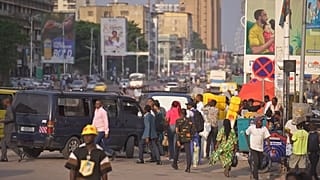
In the Democratic Republic of Congo's capital Kinshasa, NGO's are trying to teach street children skills like carpentry and baking, and a chance at a better life.
"I used to spend the night in cardboard boxes," says Daniel, a former street child. "I've learnt a lot here, I've changed, even my character has changed."
Several thousand street children, known locally as "shegues", are estimated to live in the megacity of nearly 17 million, where NGOs are trying to give them a future.
Many of the children and teenagers are pushed onto the streets because of dire poverty or because their parents accused them of witchcraft.
They manage by doing odd jobs and begging at roundabouts or on the city's long roads.
"We encounter new cases every day," said Georges Kabongo, sadly.
The educator has been running an outreach programme for more than 11 years for the Work to Rehabilitate and Protect Street Children (ORPER) NGO.
Every day, teams crisscross Kinshasa's poorest neighbourhoods to bring care and assistance to the neglected and unschooled homeless youths.
In the back of a 4X4, a nurse cleaned a gash in a boy's arm, picked up from living rough on the streets of Kinshasa, the capital of one of the world's poorest countries.
A girl also laid comatose in the back of the truck, while another aged just 13 hid her pregnancy under a baggy dirty sweatshirt.
In the working-class eastern district of Limete, the street kids' lives are marked by violence, drugs, and prostitution.
"Girls are also victims of rape. We make them aware about the risks of infection and HIV transmission," Kabongo said.
The NGO's mobile team says it helps more than 800 homeless minors every year.
Some of the children have been pushed onto the streets because their families accused them of witchcraft. "It's an excuse to be rid of them," Kabongo said.
Evangelical churches are flourishing in the capital of the vast central African nation and fake pastors claim to be able to exorcise the youngsters for payment.
"Some even go so far as to hold them captive, deprive them of food and subject them to unbearable practices," Kabongo said.
An 11-year-old girl stepped forward, barefoot, and with scars all over her body.
"It was my family that poured burning oil over me," said the girl, who ran away with her two older sisters two years ago.
The NGO teams tried to convince her to come to a centre where she could be housed and fed.
Another association also works in the same district to "restore hope" to the street children through education.
"When you graduate, you can become entrepreneurs," the French teacher for the Programme for Monitoring, Educating and Protecting Street Children (OSEPER) said.
It teaches the youngest and gives lessons in reading and writing to those who have dropped out of school, as well as professional training.
Around a hundred youngsters are learning carpentry, sewing and how to be a baker.
"When they reach adulthood, they will be able to work and be independent. The aim is for these children to reintegrate and become useful in society," Christophe Moke, an OSEPER educator said.
In the kitchen, Daniel was shaping pieces of dough.
Before being abandoned by his mother, and then his grandmother, he dreamt of having a career as a church singer.
Now, marked by the violence of living on the streets, the 17-year-old just hopes for a "stable" life.
"I often cry at night when I think of the past," the teen, who spent several months living among a group of street children, said.
"Over there, you have to be tough like them. They hit you every day and you have to steal to eat. I regret a lot of the things I did," he confided, adding he no longer had contact with his family.
The NGOs that try help them worry about the impact global cuts in humanitarian funding will have on their work.






00:52
Israeli billionaire's firm settles DR Congo graft probe for $30 million
01:04
Drone attack targets DRC's strategic Kisangani airport
01:00
Pix of the Day, 25 February 2026
01:11
DR Congo launches drone strikes on M23 at key coltan mine
01:55
Trade and hope return to Uvira after DRC-Burundi border reopens
02:19
DRC: Kinshasa's 'sapeurs' honor the father of Congolese elegance