



Guinea
Guinea has dissolved 40 political parties, including its three main opposition groups, via a late-night decree, in the latest crackdown on civil liberties under longtime strongman Mamady Doumbouya.
Doumbouya, who came to power in a 2021 coup, was elected president in late December in a vote in which all major opposition leaders were barred.
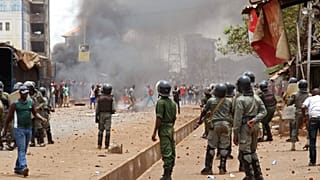
As junta leader he has ruled Guinea with an iron fist, suppressing freedoms and banning protests. Political opponents have been arrested, put on trial or driven into exile, while enforced disappearances and kidnappings have multiplied.
Guinea's minister of territorial administration and decentralisation ordered the dissolution of the parties late on Friday for "failure to fulfil their obligations".
The decree also stripped them of control of their assets. Guinea's three main political parties are among those dissolved: the UFDG led by its exiled leader Cellou Dalein Diallo, the RPG led by exiled ex-president Alpha Conde, and the UFR.
"This dissolution entails the immediate loss of the legal personality and status of the parties concerned", the order said. That includes "all political activities" as well as the use of "acronyms, logos (and) emblems" associated with the groups, it added.
The parties' assets have been placed under "sequestration" with a curator appointed to oversee their transfer, the decree said, without specifying to whom or to what entity.
Parties and civil society movements condemned the dissolution Saturday, slamming it as dictatorial. UFDG communications coordinator Souleymane de Souza Konate said that "all red lines" had been crossed in "the final act of a true political farce whose objective is the establishment of a single-party state".
Ibrahima Diallo, a leader in the pro-democracy National Front for the Defence of the Constitution (FNDC), said the move "formalized a dictatorship now established as the mode of governance.
The country is sinking into profound uncertainty." Two well-known FNDC activists, Oumar Sylla, better known as Fonike Mengue, and Mamadou Billo Bah, have been missing since July 2024.
New constitution, same leader
Doumbouya, 41, came to power in 2021 when he toppled Conde, Guinea's first freely elected president.
Guinea's new constitution, approved in a referendum last September, allowed junta members including Doumbouya to stand for election and lengthened presidential terms from five to seven years, renewable once. Doumbouya was sworn in on January 17.
Not only have opposition voices disappeared on Doumbouya's watch but so have their family members. Earlier this week several relatives of Tibou Kamara, a former minister and spokesman under Conde, were kidnapped.
Four family members of exiled musician and opposition figure Elie Kamano were abducted in November and the father of exiled journalist Mamoudou Babila Keita was kidnapped in September.
Doumbouya returned to Guinea Friday following a three-week absence that had raised questions about his health.
He had left Guinea on February 13 to attend an African Union summit in Addis Ababa, but had not been seen since.
01:07
Senegal: opponents speak out against Macky Sall's UN candidacy
00:51
Niger's military junta pulls plug on mining companies and UK oil firm
01:22
Somalia's new constitution will see directly elected lawmakers
02:24
Congo president says he will not 'remain in power forever'
01:43
Uganda: Worries grow over Kizza Besigye's health
01:03
Cameroon to release body of late opposition leader