Spanish prosecutors say 23 sexual assault cases, including nine involving children, have been reported in Ceuta since thousands of migrants crossed from Morocco into the Spanish territory at the end of July.
23 sexual assaults reported in Ceuta after migrant influx
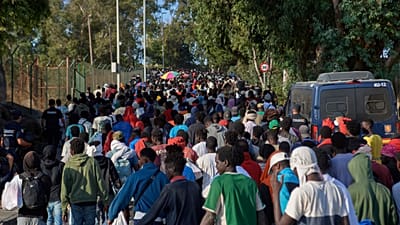
Migrants who crossed from Morocco into Spain are escorted by Spanish police to temporary shelters after being cleared from a beach in the Spanish exclave of Ceuta on Thursday,
-
Copyright © africanews
AP Photo
Ceuta's chief prosecutor, Silvia Rojas, said the figure amounted to almost one reported case a day. She told El País that migrant girls were particularly vulnerable because of their irregular status and difficult circumstances.
Around 72,000 migrants entered Ceuta on 30 and 31 July, although most have since returned to Morocco. About 5,000 remain, including an estimated 1,400 to 1,600 children.
Spanish news agency Efe reports that suspects in the sexual assault cases include four Moroccans, three Spaniards and a Belgian.
The influx has placed significant pressure on the territory, with tensions between migrants and local residents leading to incidents of violence.
Rojas said the number of sexual assaults had increased sharply following the arrivals, but warned that the actual figure could be higher because some victims had not reported the attacks.
Doctors at Ceuta University Hospital have treated several suspected victims. Emergency doctor Susana Ascaso said one of them was a 10-year-old child.
The Spanish government has approved a multi-million-euro aid package to provide essential services and support for unaccompanied children. Prime Minister Pedro Sánchez has also convened the national security council twice within a week to address the crisis.
Sánchez's government is facing criticism from opposition parties over its handling of the situation. Ceuta's regional president, Juan Jesús Vivas, has called for demonstrations in support of the territory.
The crisis has also raised tensions between Spain and Morocco. Rabat claims sovereignty over Ceuta and neighbouring Melilla, although both are administered by Spain.
Sánchez has avoided accusing Morocco of organising the mass crossing, saying there is no intelligence pointing to Moroccan government involvement.
Instead, he has blamed online disinformation, which he said was amplified by networks linked to Russia, Israel and the international far right. Both Russia and Israel have rejected the allegations.
Morocco has also denied organising or being involved in the mass crossing.
Spanish fact-checking organisation Maldita said messages encouraging people to attempt the crossing had circulated on Moroccan social media before the influx.
At least 100 people died while attempting to reach Ceuta by sea, according to figures cited by the city's authorities.