"To say it's immigration is to attack an entire community."
France's unrest: Why are immigrants being blamed for the violence?
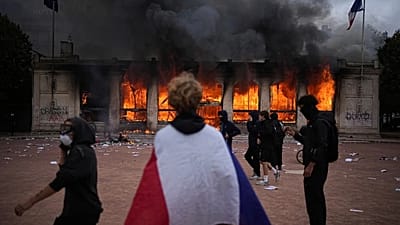
A protester wraps a French flag around them in front of the burning tourism office during
-
Copyright © africanews
AP Photo
For Diabagate Adama, an African immigrant who has spent nearly a decade working in France's private security industry, blaming migrants for the violence that has shaken the country is both unfair and misleading.
From the Yellow Vest protests to disturbances surrounding major football matches, Adama has witnessed many periods of protests. He, however, says the latest violence has been particularly alarming.
While he worries about the impact on businesses and livelihoods, a different narrative is emerging from political leaders thousands of kilometres away.
US President Donald Trump has declared that France is "burning", blaming immigration for what he described as the country's decline.
His vice-president, JD Vance, and Hungarian Prime Minister Péter Magyar have also linked the violence to migration, using the unrest to defend tougher border policies.
But the demonstrations began with French students demanding better schools before growing into nationwide protests over rising living costs and public services.
So how did a crisis rooted in domestic grievances become an international argument about immigration? And what does that debate mean for Africans who have made France their home?
From school protests to nationwide unrest
The unrest began in September, when students took to the streets to protest deteriorating school buildings, teacher shortages and other problems affecting education.
Their frustration soon spread beyond classrooms, drawing support from teachers, trade unions and other groups unhappy with the rising cost of living and government spending plans.
By Saturday, 17 October, more than 550,000 people had joined demonstrations across France, according to official estimates.
While many marched peacefully, some protests descended into violence.
The violence has added to the pressure on Macron's government, already struggling with political divisions, mounting debt and a difficult battle over public spending.
But outside France, the unrest has taken on a different political meaning.
'You cannot blame an entire community'
Adama, who has managed security operations in Paris since 2017, says he was surprised by the scale of the destruction.
"This time, I think the crisis has been extremely violent," he told Africanews.
"We've seen crises involving damage, looting and clashes between police and demonstrators."
he however says attacks on public buildings and symbols of the French state have made the latest unrest particularly disturbing.
He also believes many businesses were inadequately prepared.
Security arrangements that might normally be strengthened ahead of major events were not put in place because few expected the demonstrations to become so destructive.
But when asked whether immigration was responsible for the disorder, Adama rejected the suggestion.
"You cannot necessarily say that immigration is responsible for this disorder," he said.
"To say it's immigration is to attack an entire community."
He points to the students who began the protests, arguing that they came from different backgrounds.
"Among the students, there are people of all races and all communities," Adama added.
His comments highlight a concern at the heart of the immigration debate: the risk of holding entire communities responsible for the actions of individuals.
'We don't feel threatened'
Despite the increasingly heated political rhetoric, Adama says he does not personally feel threatened as an African immigrant living in France.
His biggest concern is economic.
"We don't feel threatened. The only problem is that it reduces business activity," he said.
His work involves providing security personnel to shops and other commercial premises.
When those businesses are damaged or forced to close, the consequences can extend to security companies and their employees.
Adama explains that some affected premises could take weeks or even months to reopen, disrupting security contracts and potentially reducing income.
"That's where we lose out," he said.
For security companies, the challenge is particularly difficult because employees still have contractual rights even when circumstances beyond their control prevent them from working.
What does this mean for Africans in France?
France's relationship with Africa stretches back centuries, shaped by colonial history, migration, trade and cultural ties.
Today, people with roots in countries like Tunisia, Algeria, Senegal, Morocco, Mali and Côte d'Ivoire form part of French society.
Their experiences, legal status and relationships with France differ considerably.
Yet political arguments about immigration can sometimes blur those distinctions, particularly when debates about migration become linked to national security or public disorder.
The latest unrest comes as France prepares for a presidential election in 2027, with immigration and national identity already prominent political issues.
Marine Le Pen's far-right National Rally has long advocated tougher immigration controls and is seeking to expand its political influence.
The comments from Trump, Vance and Magyar show how events in France are also being drawn into a broader international debate about migration.
A crisis bigger than immigration
France now faces the difficult task of restoring calm while addressing the frustrations that brought hundreds of thousands of people onto the streets.
For some politicians abroad, the violent scenes have become a warning about immigration.
For others, they reflect deeper economic and social problems that cannot be explained by migration alone.
And for people like Adama, the crisis is being felt in more immediate ways.
But amid the debate over immigration, a more fundamental question remains: how did protests over schools and living standards become a controversy about who belongs in France?