Africa will be represented by 10 national football teams at the 2026 FIFA World Cup across the United States, Canada and Mexico, with a mix of locally-born and foreign coaches leading the continent’s biggest football nations.
World Cup 2026: who coaches Africa’s 10 qualified teams?
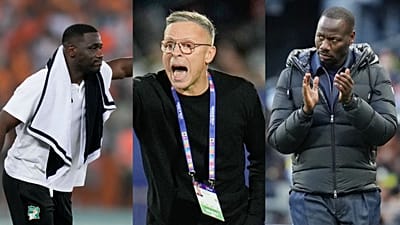
Ivory Coast 's coach Emerse Fae , Morocco's coach Mohamed Ouahbi, Senegal's coach Pape Thiaw reacts
-
Copyright © africanews
AP Photo
The tournament will feature Algeria, Ghana, DR Congo, Senegal, Morocco, Tunisia, Egypt, Cape Verde, South Africa and Côte d’Ivoire according to FIFA.
Homegrown coaches dominate key African sides
A majority of Africa’s World Cup representatives will be led by African-born coaches, a trend that is gradually growing in recent international tournaments.
Pape Thiaw
Senegal are under the leadership of Pape Thiaw, who stepped up following Aliou Cissé’s long tenure with the national team.
Mohamed Ouahbi
In Morocco, Mohamed Ouahbi is leading the boys to the tournament, replacing Walid Regragui after a reshuffle in the technical setup.
Emerse Faé
Côte d’Ivoire are coached by Emerse Faé, who guided the team to Africa Cup of Nations glory in 2024 and was later rewarded with a permanent contract.
Hossam Hassan
Egypt are led by former national striker Hossam Hassan, while Cape Verde remain under the stewardship of long-serving coach Bubista (Pedro Leitão Brito).
Sabri Lamouchi
Tunisia’s situation has been widely reported as Sabri Lamouchi, whose appointment has triggered debate over whether he should be classified as a homegrown coach due to his dual heritage and coaching background in France.
Depending on classification, this brings the number of African-born coaches at the tournament to either six or seven.
Foreign experience still heavily relied on
Despite the rise in local coaching leadership, several African federations continue to rely on experienced European coaches..
Ghana are now led by veteran Portuguese coach Carlos Queiroz, appointed to bring experience to a squad drawn in a difficult group.
Algeria are coached by Vladimir Petković, the Bosnian-Swiss tactician who previously guided Switzerland to multiple major tournaments.
South Africa remain under Belgian coach Hugo Broos, who led the country through qualification and has previously managed Cameroon.
DR Congo are coached by Frenchman Sébastien Desabre, who has built a reputation across African club and national football.
A shifting coaching identity in African football
The mix of coaches heading into the 2026 World Cup highlights a broader transition in African football management.
Some federations have doubled down on local identity and continuity, while others continue to prioritise international experience for global tournaments.
At the Africa Cup of Nations in 2024, all semi-finalists were coached by African-born managers, reinforcing the growing credibility of homegrown coaching talent on the continent.
The bigger picture
With 10 African teams heading to the tournament, expectations are rising that at least one nation could challenge beyond the group stages.
But beyond results, the coaching story is becoming central: not just who qualifies Africa for the World Cup, but who is trusted to lead them there.