The sole airport providing humanitarian organisations access to the epicentre of an Ebola outbreak in the Democratic Republic of Congo reopened on Tuesday, when the reported number of suspected cases declined.
DR Congo airport reopens in Ebola-hit area as suspected cases drop
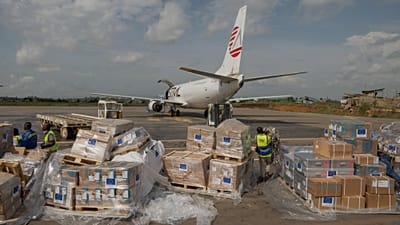
Bunia is used by humanitarian organisations to access the epicentre of the Ebola outbreak
-
Copyright © africanews
AP Photo
The country of 100 million people declared on May 15 that it was battling a major epidemic of the highly contagious haemorrhagic fever, prompting the World Health Organization to issue an international health alert.
WHO Director-General Tedros Adhanom Ghebreyesus, who spoke to Congolese President Felix Tshisekedi on Monday, travelled to the epicentre of the outbreak on Saturday.
Out of 321 confirmed cases of infection, 48 deaths have been recorded, according to Congolese health authorities and the WHO.
Fifteen cases, including one death, have also been reported in neighbouring Uganda, according to the Ugandan Ministry of Health.
On Tuesday, the WHO reported that the number of suspected cases had declined to 116 from 906 late last week, based on information provided by the Congolese authorities.
A report released on Friday by the African Union's health agency, Africa CDC, had cited 1,139 suspected cases, including 246 deaths probably caused by the disease.
Many patients "have been cleared out" from the data after having been shown to have other diseases with similar early symptoms or an unlinked fever, WHO spokesman Christian Lindmeier said in Geneva.
Few laboratory tests have been carried out, mainly due to a lack of resources in the DRC.
Kenyan protest turns deadly
The Congolese government, which recently announced the recovery of several patients, has in recent days launched a major communication campaign to assure the public that "the situation is under control".
In Kenya, violent protests broke out on Monday over an Ebola quarantine facility reserved for US patients arriving from the DRC.
Demonstrators voiced anger at the United States using Kenyan soil and bringing Ebola patients into the country.
They were met with tear gas from police and rights group VOCAL Africa said on Tuesday a 27-year-old man had been "shot and killed" during the protests, dying "on the spot".
Kenyan President William Ruto defended the facility saying was "part of a broader national preparedness system", adding that it "will be there to serve the people of Kenya and to serve our friends, including the Americans".
Bunia airport reopens
The outbreak was declared in the Ituri, in the northeast of the DRC -- which is one of the poorest countries in the world.
No vaccine or approved treatment is available for the Bundibugyo strain of the virus behind the current outbreak of Ebola and efforts to contain its spread rely mainly on preventative measures.
Most large outbreaks known in the past have been caused by the Zaire virus, the only one for which a vaccine is licenced.
Hoped-for vaccine
Ebola, which is passed on through close contact and bodily fluids, has killed more than 15,000 people in Africa over the past 50 years.
The deadliest outbreak in the DRC claimed nearly 2,300 lives out of 3,500 cases between 2018 and 2020.
Africa CDC says it hopes a Bundibugyo vaccine will be ready by the end of the year.
The health risk is "high" for countries neighbouring the DRC but remains "low" at the global level, according to the WHO.
On May 23, the authorities suspended all commercial flights to and from the airport in Bunia, the capital of Ituri in the conflict-plagued eastern DRC, allowing only medical and humanitarian planes in.
Health Minister Samuel Roger Kamba said the authorities needed to put health measures in place to protect travellers.
On Tuesday, the transport ministry said the authorities had assessed how the outbreak was being monitored and concluded "conditions are now in place for a gradual and safe resumption of flights".