When health officials talk about Ebola or other infectious diseases, the words they choose are not interchangeable.
What is an outbreak, epidemic or pandemic? Ebola and public health emergencies explained
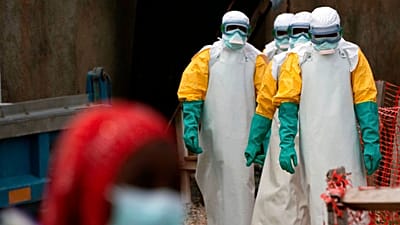
FILE - Health workers dressed in protective gear begin their shift at an Ebola treatment center in Beni, Congo, July 16, 2019.
-
Copyright © africanews
AP Photo
Terms like outbreak, epidemic, pandemic and public health emergency each describe a different level of spread, and they help determine how fast and how far the response goes.
From local spike to global threat
An outbreak is usually the starting point. It refers to a sudden rise in cases in a specific place, a town, district, or sometimes a country. It’s tightly contained, at least in the early stages.
An epidemic is bigger. It means a disease is spreading more widely than expected within a region or population, putting pressure on local health systems.
A pandemic goes further still. That’s when an epidemic crosses borders and spreads across multiple countries or continents, becoming a global concern.
These definitions, used by bodies such as the World Health Organization and the Centers for Disease Control and Prevention, are less about labels and more about scale and response.
Ebola and how it spreads
Ebola virus disease is one of the most severe infectious diseases known. It spreads through direct contact with the blood or body fluids of an infected person, or contaminated objects like needles or bedding.
Symptoms usually appear between 2 and 21 days after exposure. While survival depends on the outbreak and the quality of care available, the average fatality rate has historically been high, though it varies significantly between outbreaks.
Why the terminology matters
These distinctions are not academic. They guide decisions on surveillance, travel guidance, isolation measures, and international support.
An outbreak may trigger a focused local response. An epidemic or pandemic demands wider coordination, often involving international partners, emergency funding, and large-scale public health interventions.
A public health emergency is declared when the situation is urgent enough to require immediate, coordinated action to limit harm and stop further spread.
Lessons from West Africa
The 2014–2016 Ebola crisis showed how quickly a local outbreak can escalate. It began in Guinea, before spreading to Liberia and Sierra Leone.
By the time it was brought under control, more than 28,000 people had been infected and over 11,000 had died, making it the largest Ebola outbreak on record. The World Health Organization later declared it a Public Health Emergency of International Concern.
Recent outbreaks and ongoing risk
Ebola has not disappeared. In recent years, the Democratic Republic of the Congo has continued to report and respond to outbreaks, including one declared in 2025 in the Kasai region.
Health authorities say rapid detection, contact tracing, protective equipment, and community engagement remain the backbone of containment, especially in areas where health systems are stretched.
At the same time, vaccines and treatments now exist for some strains, improving survival chances and prevention. But experts warn that early response still makes the biggest difference.
Why it matters for readers
These terms shape how the world reacts to disease threats. An outbreak does not automatically become a pandemic, and even a local epidemic can be devastating if it is not controlled early.
In Ebola’s case, the language is not just technical, it signals urgency, risk, and the level of response already in motion.