At Goma’s central market, once the beating heart of the local economy, traders waited for customers who were becoming increasingly scarce due to the economic crisis that has engulfed the city since it was occupied by the M23 rebel coalition a year ago.
One year into M23 control, residents are struggling to get by in DRC's eastern capital
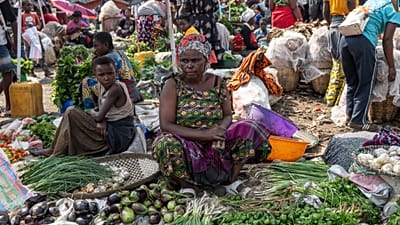
Espérance Mushashine, 44, mother of 12, sells vegetables at the Kituku market on the shores of Lake Kivu in Goma, Democratic Republic of the Congo, Monday, Jan. 26, 2026
-
Copyright © africanews
Copyright 2026 The Associated Press. All rights reserved.
Rwanda-backed M23 is the most powerful of over 100 armed groups vying for a foothold in mineral-rich eastern Congo, near the border with Rwanda.
The conflict has created one of the world’s most significant humanitarian crises, with more than seven million people displaced, according to the United Nations agency for refugees.
Following a sharp escalation of fighting early last year, M23 rebels took over Goma, which remains in their hands today.
Sitting behind her vegetable stall, Espérance Mushashine, a 44-year-old mother of 12, said she has been selling vegetables for years.
For the past year, she has watched helplessly as her business has declined.
“Before, we used to buy in bulk at an affordable price. Sales were good and we managed to get by. Today, prices have risen sharply and, once at the market, customers hardly buy anything anymore. We’re holding on as best we can, but the situation isn’t improving," said Mushashine.
Business flight
Due to the war, many local businesses have closed, and international companies have left Goma, the capital of North Kivu.
Grâce Omar said he is just one of many residents who has lost hope of finding work.
Sitting in his living room with his family, he said the rise in unemployment and the collapse of job opportunities was to blame.
“Even the small consulting contracts that I could hope for here and there (before) have become difficult to hope for today. It is difficult to get a consulting contract with a local or international organisation because these organisations themselves are reducing their staff. It’s a difficult situation," said Omar.
In downtown Goma, banks remained one of the most striking symbols of the economic crisis in the city.
Once bustling with customers coming and going, they were now surrounded by buildings with closed doors.
University of Goma economics professor, Déo Bengeya, described an economy paralysed by the absence of financial institutions.
According to him, without banks, recovery remains impossible: no credit, no investment, no security for savings.
“The closure of banks and microfinance institutions does not facilitate the circulation of capital and currency, nor does it make it easier for the economy to return to normal”, said Professor Bengeya.