At only 2 weeks old, this baby was released from Beni’s Ebola treatment center on Friday.
“Baby Hema” survives Ebola after being born in treatment center
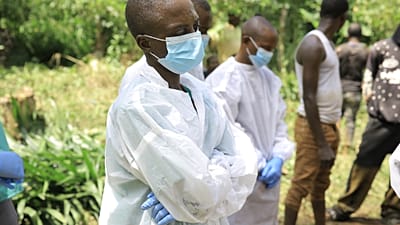
Relatives and healthcare workers prepare to bury Sylvain Kasereka Munganga, a 19 year old victim of Ebola, in Beni, North Kivu province, Congo, Tuesday, Nov. 24, 2026
-
Copyright © africanews
Copyright 2026 The Associated Press. All rights reserved
He was born in the treatment center. His mother was sick with Ebola and was being cared for there.
A few days after his birth, she died.
He still does not have a name. Staff at the Ebola treatment center call him “Baby Hema”, after the ethnic group he is from.
They say they are caring for him while they search for his family, a difficult task in eastern Congo.
For three decades, a violent conflict has raged in the region, setting off one of the world’s worst displacement crises.
The baby boy’s parents are not from Beni, but from Ituri province further north.
Staff have been unable to find his extended family.
The names of the parents are being withheld to protect the identity of the newborn due to the stigma associated with Ebola.
Pediatrician Christophe Mukulu said the baby is one of only three or four infants who left the Ebola treatment center alive.
“A newborn baby does not yet have good immune defenses, which makes him very fragile when he is, from birth, already being attacked by a major disease–a major disease like Ebola,” he said.
The baby boy’s recovery is one he will not forget, he said. “The joy of a doctor, in general, is to see the patient recover. And the joy of a pediatrician is to see children recover. And in an epidemic context like this, you can imagine, we count a lot of deaths.”
The Ebola outbreak in eastern Congo, caused by the Bundibugyo virus, has killed more than 5,700 people since May, with a case fatality rate of nearly 50%.
But children are hit even harder.
The World Health Organization has noted a higher fatality rate in children during this outbreak, and Doctors Without Borders said Ebola is “disproportionately impacting children”.
According to UNICEF(United Nations International Children's Emergency Fund), nearly 72% of infected children in the under-5 age group have died, a fatality rate much higher than adults.
Mukulu said it’s too early to say exactly why children are so disproportionately impacted.
“We manage to save some of them,” he said. “But inevitably, some of them die.”
This baby boy will now be cared for in the hospital’s nursery, where babies and toddlers who have recovered from Ebola, and babies whose parents have died of Ebola, are cared for.
“For the two-year-olds, we play with balls and other toys, helping them feel at ease so they aren't burdened by the fact that they have become orphans,” said caregiver Nadine Muvunga.
She gave a bottle to the newly arrived baby boy.
“Since the baby is so tiny, we will look after him and rock him just as their own parents would,” she said.