He has arguably done more than any living painter to bring black figures into Western galleries, but Kerry James Marshall is still uncomfortable with being seen as a trailblazer.
African-American artist’s work celebrated in travelling retrospective
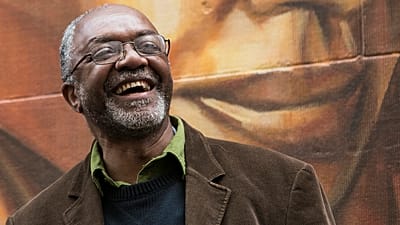
Artist Kerry James Marshall at the unveiling of his mural honouring women who have shaped the city, Chicago, 4 December 2017.'s arts and cultu
-
Copyright © africanews
Ashlee Rezin/Chicago Sun-Times/AP
Highly acclaimed in his home country, the United States, a major retrospective of his work opened on Wednesday in France at the Musée d’Art Moderne de Paris.
"It's not a reasonable assumption to believe that there were no black people in pictures before I had some kind of revelation that they should be there," said the Alabama-born artist.
He cites the work of his American mentor Charles White (1918-1979) -- a man he compares to some of the greatest figurative painters -- as well as portraits by the 16th-century Dutch painter Hieronymus Bosch or even the statues of Ancient Greece.
But few other contemporaries can compete with how Marshall has mainstreamed black portraiture. He counts stars from Sean Combs to Jay-Z as collectors, holds the auction record for a living black artist, and is now being honoured like never before outside his home country.
The exhibition includes monumental works such as "De Style" (1993), depicting the clients of an African American hair salon who stare out at the view of a wall calendar showing the date of Rodney King’s beating by police officers in Los Angeles in 1991, which led to race riots.
In "Black Painting" (2003), another large-format work, a barely discernible couple embrace in a dark bedroom, with a book by Angela Davis, the African American activist and former member of the Black Panthers, on the bedside table.
"The first thing you see is that they're black figures, but then you have to move on from that to everything else that's happening in the picture," Marshall said.
But beyond the deliberate references to significant figures or dates in America's violent history of race relations, much of Marshall's work carries a simple, but powerful message about representation.
He spotlights black people in often banal, everyday settings -- in a beauty salon, lying in a park -- echoing the codes of classical European portraiture in which the black subjects, if painted at all, were usually either shown as servants or slaves.
In Marshall's hands, the skin colour of his figures is rendered in jet-black.
The blackness is "a rhetorical device, not just as a marker of a certain kind of identity, but to create an aesthetic framework in which people can think about blackness as more than just a simple dead end.
"Blackness is not a dead end, it's not a non-colour. It's something that can be as complex and as rich as any other colour that one might use to make a painting," he explained.
Now aged 70, Marshall spent his early years in racially segregated Birmingham, Alabama, before his family moved to Los Angeles in the 1960s in search of greater opportunities.
Living in predominantly black and poor South Central, hel witnessed the rise of organised gang violence there, as well as the 1965 Watts riots, a six-day uprising fuelled by racial tension.
He broke through as a major figure in the American art world relatively late, enjoying his first major retrospective only ten years ago at the Museum of Contemporary Art Chicago.
The travelling retrospective of his work named "The Histories" has won rave reviews in London and Zurich. It runs in Paris until January 2027.