As the Ebola outbreak continues to spread in the eastern part of the Democratic Republic of the Congo, calls are growing for better coordination of the Ebola response with local communities and community leaders.
Fear and mistrust among communities undermine Ebola response efforts
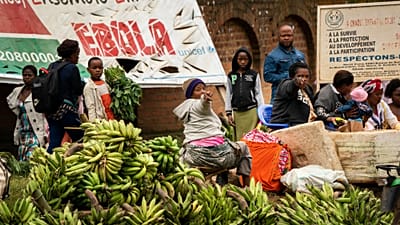
Ebola mistrust among communities.
-
Copyright © africanews
AP Photo
On Tuesday, August 25, in Beni, Papy Kasereka, a former team leader for risk communication and community engagement during the 10th Ebola outbreak and now an analyst, spoke about weaknesses in the current Ebola response.
“We must not continue to treat ETCs as something mysterious. We need to demystify the operations of the ETCs by giving community leaders the opportunity to visit it and see what is happening”, said Kasereka. “It is therefore important to open the doors of the Ebola Treatment Centers (ETCs) to community members and community leaders, so that those who have recovered can communicate directly with the communities.
This will help demystify the management of the ETCs,” he added. Congolese Ministry of Health data showed that as of Saturday, the outbreak had recorded 5,514 cases and 2,642 deaths, including 317 deaths reported in the previous seven days. But Congolese experts said the outbreak that started weeks before it was confirmed could be three times the known size.
This is the fastest-growing Ebola outbreak in history, with many people dying outside treatment centers. It has recorded seven times more deaths at this stage than the 2014-2016 West Africa Ebola outbreak, which is the deadliest in history with more than 11,000 deaths overall.
Most new cases in Ituri province, the current epicenter, still come from outside monitored contacts. Nearly half of people infected have died — 47.9% — but the government data shows much higher rates in hard-to-reach areas such as North Kivu province, which has a fatality rate of 68.6%. “I believe that to defeat an epidemic, we must place communities at the heart of epidemic management.
Communities are not mere spectators watching the epidemic spread or claiming lives. We must make communities our allies. We must reach out to them. We must work with them, and that, I believe, is what is missing," Kasereka said.
The Ebola response has also faced resistance and attacks on treatment centers and response teams. Michel Tosalisana, chief medical officer of the Beni Health Zone, said attacks on Ebola response teams would not help young people or their communities. “It is not by attacking the Ebola response teams that they (the young people) are preparing for their future; on the contrary, they are destroying their future by doing so.
So if there is resistance, we must remind these young people — who are most often behind these protests — that the Ebola response teams are there to protect the health of the entire population,” Tosalisana said.