Thousands of displaced families in Sudan's strategic city of El-Obeid are facing worsening humanitarian conditions as fighting between the Sudanese army and the paramilitary Rapid Support Forces continues.
Displaced families and hospitals struggle as Sudan's war ravages El-Obeid
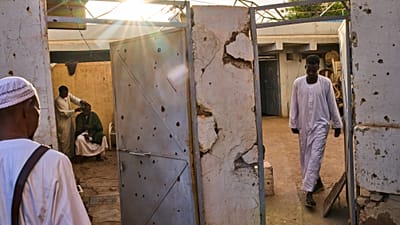
Sudanese men walk inside the war-damaged Sheikh GaribAllah Mosque in Omdurman, on the outskirts of Khartoum, Sudan, Friday, April 17, 2026.
-
Copyright © africanews
AP Photo
Drone strikes have damaged fuel supplies, power infrastructure and key transport routes, leaving hospitals struggling to keep life-saving equipment running and civilians without essential services.
Among those caught in the crisis is Amna, who fled the violence after her husband was killed during the war.
"My husband was killed while I was four months pregnant, killed in this war. We have been suffering since the day we arrived. We don't have anything. I don't have a bed, I don't have a pan, I don't have a bucket. I don't have any food."
At El-Obeid Teaching Hospital, doctors are battling frequent power cuts as diesel shortages threaten emergency care, maternity services and incubators for premature babies.
Dr. Muzammil Ahmed al-Safi, Director General, El-Obeid Teaching Hospital: "Unfortunately, only 10 minutes the generator was off because the fuel is depleted... But as you know, now the emergency room is functioning as normal."
The war, which began in April 2023, has killed at least 59,000 people, displaced around 13 million, and pushed large parts of Sudan into famine. The United Nations says more than 30 million people now require humanitarian assistance as fighting intensifies around El-Obeid.