UNAIDS warned Monday that global funding cuts, growing inequality and setbacks to human rights are threatening decades of progress in the fight against HIV/AIDS.
UNAIDS warns funding cuts threaten progress to eliminate HIV/AIDS
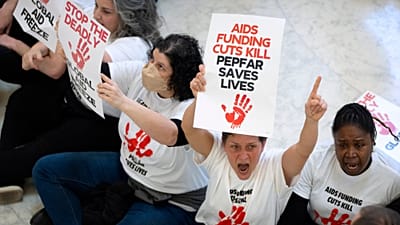
Demonstrators protest against cuts to American foreign aid spending to combat HIV/AIDS, at the Cannon House Office Building on Capitol Hill, Feb. 26, 2025.
-
Copyright © africanews
Copyright 2025 The Associated Press. All rights reserved.
Launched in Rio de Janeiro, the United to End AIDS report examines the impact of funding disruptions in 2025 and global progress toward ending AIDS as a public health threat by 2030.
UNAIDS Executive Director Winifred Byanyima said scientific advances have put an end to AIDS as a public health threat within reach, but warned that those gains are being jeopardized by declining investment and unequal access to prevention and treatment.
"Today, we have prevention medicines so effective that if they reached everyone who needs them, we can realistically end AIDS as a public health threat. The second story is a warning. Funding cuts, rising inequality, attacks on human rights, shrinking civic space. Together, they are putting decades of progress at risk," Byanyima said.
According to Byanyima the biggest obstacle to ending AIDS is no longer scientific, but political, and that continued cuts to HIV funding could undermine prevention and treatment programs, leading to more new HIV infections and AIDS-related deaths.
The report was presented during the International Aids Conference in Rio de Janeiro, that takes place until 31 July 2026.