Mauritania says tougher border controls are sharply reducing migrant departures to Europe from its Atlantic coast. But for many West Africans stranded in the country, the dream of reaching Europe remains as strong as ever. AFP's report from Nouadhibou examines the impact of the crackdown and the frustrations driving migration.
Mauritania crackdown slows migrant departures but not dreams of Europe
Agencies
-
Copyright © africanews
Copyright 2023 The Associated Press. All rights reserved.
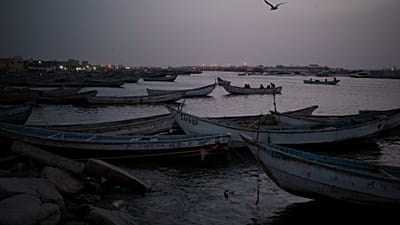
Nouadhibou, a fishing city on Mauritania's Atlantic coast, has long been one of West Africa's main departure points for migrants hoping to reach Spain's Canary Islands.
Thousands of migrants from Senegal, The Gambia, Guinea and beyond have passed through the city, often working for months to save enough money for a dangerous sea crossing aboard overcrowded wooden pirogues.
But over the past year, Mauritanian authorities have intensified patrols, strengthened coastal surveillance and arrested suspected smuggling networks as part of a migration management partnership backed by the European Union.
Officials say the measures are having a clear impact.
Ahmed Moulaye, Head of the Fight Against Irregular Maritime Migration, Mauritanian Coast Guard:
"There have been drops in departures from Nouadhibou, from Nouakchott itself, so from the Mauritanian coast, I would say. Because, as I mentioned with the figures, in 2024 it was more than 8,000, in 2025, around 4,000-something, 4,300, and in the fourth month of 2026 we have intercepted only 126 migrants, candidates for immigration."
While authorities point to falling numbers, many migrants say increased security has left them trapped rather than discouraged.
Police checks and deportations have become a constant concern for undocumented migrants living in Mauritania. Human rights groups have also raised concerns over reports of abuse and mass expulsions.
Yet despite the risks, many migrants continue to see Europe as their only chance for a better future.
Ahmed, a 34-year-old Senegalese migrant, says economic hardship leaves many young Africans feeling they have little choice but to leave.
Ahmed, Senegalese migrant (identity protected):
"There is not a single young African who wants to stay in Africa. We all have the desire to go to Europe."
The European Union has increasingly relied on partnerships with transit countries such as Mauritania to curb irregular migration before migrants reach European shores.
The EU says its support is aimed at improving border management, combating smuggling networks and providing humanitarian assistance to migrants rescued at sea.
But for migrants waiting in Nouadhibou, stricter controls do not address the underlying reasons people leave home.
Many cite unemployment, poverty and the lack of legal migration pathways as the real drivers of migration.
Laylay, a Senegalese mason who has already attempted the Atlantic crossing three times, believes opportunities and mobility are the key to reducing irregular departures.
Laylay, Senegalese migrant hoping to return home (identity protected):
"Now, if you want irregular migration to stop, you have to give people visas and also African states need to open factories to allow young people to work, because that is all we are looking for. We just want to work, and if we had the opportunities at home, we would have stayed."
As Mauritania tightens its borders and Europe hardens its migration policies, departures from the country's shores may be falling. But for many migrants gathered in Nouadhibou, the forces pushing them to leave remain firmly in place.