Madagascar's traditional New Year, Alahamady Be, a pre-colonial custom abandoned for decades, has now been revived with rituals honouring ancestors, sacred fire and purification ceremonies.
Crowds flock to Antananarivo as Madagascar restores Its pre‑colonial new year
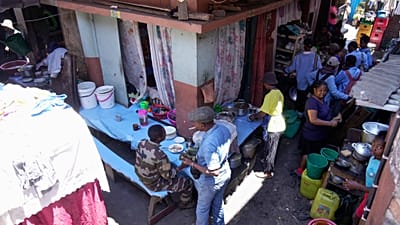
A view of an open market in Antananarivo, Madagascar, Tuesday, Oct. 14, 2025
-
Copyright © africanews
Copyright 2025 The Associated Press. All rights reserved
The event drew large crowds to Antananarivo's Mahamasina Stadium, with some dancing and enjoying local bands and music.
The organiser, Mikolo Hasina Ankoay, said this will help rejuvenate the identity of the Malagasies after several years of lost glory.
"Much of what defines Malagasy identity has been lost, destroyed, or has crumbled away. We were plunged into a deep slumber, as if under the spell of a very powerful enchantment, almost to the point of overdose. Today, we must wake up, regain our senses, and realise that there is blood flowing through our veins — and that blood is Malagasy," said Mikolo Hasina Ankoay Andrianarisoa, organising chairperson and the guardian of the tradition.
The highlight of the New Year took place on Thursday, March 19. Residents and visitors of Antananarivo were offered a traditional dish, tatao — rice cooked in milk and topped with honey, a symbol of abundance. This tasting was followed by tsodrano — a solemn blessing.
"The sacredness of Manjakamiadana is also being restored, and that is essential. After so long, we were finally able to perform the rituals freely and in full on the sacred stone, without any obstruction. This is very important, with a major impact on the nation's life and future. It had not happened since the time of the kings. Today, on this New Year’s Day, it brings us great joy," said Davida Rakoto, the organiser and guardian of the tradition.
Manjakamiadana was a 19th-century sacred place and the seat of the Kingdom of Madagascar.
The events took place in the main squares and emblematic locations of the capital, Antananarivo: Kianja Barea Mahamasina, the University of Antananarivo, as well as at historic cultural heritage sites such as the Rova of Ambohidrabiby
"Ambohitrabiby is the birthplace of the Merina kingdom, and celebrating the Malagasy New Year here is deeply sacred. That is why the symbol of the fire is lit here first, before being carried across the whole city – and even throughout Madagascar," said Violette Randrianjatovo, deputy headteacher at a French school abroad.
The festivities will conclude with hiragasy, a traditional musical and theatrical performance with songs and dances, illustrating the richness of Malagasy cultural heritage.