In a remote northwestern Nigerian community, families are pleading for the release of over 150 worshippers abducted from churches last Sunday, even as the government announces a breakthrough in securing delayed U.S. military aid to combat the nation’s spiraling violence. The dual developments highlight a nation caught between relentless terrorist attacks and a complex diplomatic path to greater firepower.
Nigeria's defense equipment from US to be delivered after five years
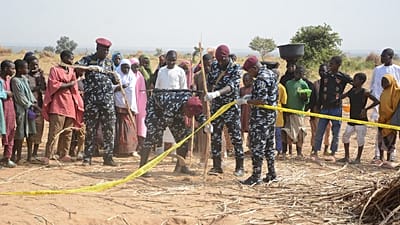
Nigeria police, Anti-Bomb squad, secure the scene of a U.S. airstrike in Northwest, Jabo, Nigeria, Friday, Dec. 26, 2025.
-
Copyright © africanews
Tunde Omolehin/Copyright 2025 The AP. All rights reserved.
The stark reality of Nigeria’s security emergency was underscored on June 23, when armed men stormed three churches during Sunday services in Kurmin Wali, Kaduna state.
Masked gunmen seized congregants, fleeing into the surrounding forests. By Thursday, the assailants had demanded a ransom of 17 motorcycles from the hostages’ impoverished families, according to local residents.
This brazen mass abduction is the latest in a persistent pattern of assaults on religious centers and communities across Nigeria’s north.
Unlocking the arsenal: U.S. pledges delayed equipment
Against this backdrop of crisis, Nigeria’s government announced on Friday that the United States has committed to delivering outstanding military equipment purchased by Abuja over the past five years.
The promised matériel includes drones, helicopters, tactical platforms, spare parts, and support systems.
“We want Nigerians to know that this partnership is working,” Information Minister Ibrahim Idris stated following a high-level meeting in Abuja between U.S. officials and Nigeria’s National Security Adviser, Nuhu Ribadu.
From diplomatic strain to security cooperation
The arms pledge marks a significant step in mending relations strained by the U.S. designation of Nigeria as a “Country of Particular Concern” for religious freedom violations.
The meeting was the third such high-level discussion since November, aimed at moving past this diplomatic hurdle.
The shift towards cooperation was signaled earlier when, on December 25, U.S. forces conducted airstrikes on Nigerian soil for the first time, targeting Islamic State affiliates in Sokoto state.
Minister Idris emphasized the government’s resolve, saying, “Nigeria is acting decisively. Security agencies have clear instructions to protect communities and respond swiftly to threats.”
A multifaceted war with no quick end
Nigeria is grappling with a hydra-headed security crisis. Islamist insurgents like Boko Haram and the Islamic State West Africa Province (ISWAP) battle the military in the northeast, while militant gangs, locally called “bandits,” terrorize the northwest with mass kidnappings for ransom and attacks on villages.
The promised U.S. equipment is seen as vital for intelligence, surveillance, and rapid response capabilities.
However, the crisis in Kurmin Wali persists, with over 150 lives hanging in the balance, a somber reminder that advanced hardware alone cannot swiftly undo the deep-rooted instability plaguing Africa’s most populous nation.