Even as Sudan’s civil war continues, reconstruction is underway in the capital Khartoum where the army-backed government says it plans to return gradually.
Reconstruction underway in Khartoum even as war in Sudan continues
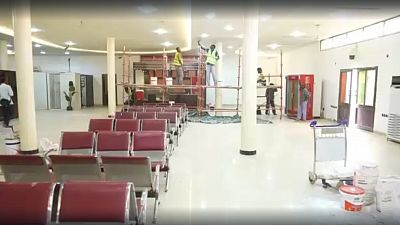
Reconstruction at Khartoum Airport, August 2025
-
Copyright © africanews
Cleared
Many roads in the city have been cleared, rubble is being removed, and cranes now punctuate the skyline.
The army retook Khartoum last March from the paramilitary Rapid Support Forces (RSF) which it has been battling for nearly three years.
Prime Minister Kamil Idris’ government has been operating from the Red Sea city of Port Sudan some 700 kilometres away since the start of the war.
Now, officials tour reconstruction sites daily, promising a swift return to normal life.
Government headquarters have been refurbished, but many ministries remain abandoned, their walls pockmarked by bullets.
For residents and businesses, many problems remain. On Liberty Street, Khartoum's main commercial avenue, only a few of the looted shops have reopened.
"Many shopkeepers aren't coming back," said Osman Nadir, an appliance seller.
He said that before the war, they used to obtain good from companies either on deferred payment terms or through specific credit-based arrangements.
"Suppliers are demanding repayment for goods destroyed during the fighting," said Nadir, who himself faces legal action.
More than a third of Khartoum’s nine million residents fled when it was seized by the RSF in 2023. Over a million have returned since the army retook the city.
But the airport remains closed, people have no money, and restoring water and electricity remains the most urgent task.
Tea-seller, Halima Ishaq, fled south when the fighting began in April 2023 and came back just two weeks ago.
"Business is not good. The neighbourhood is still empty," the mother of five said.
Ishaq earns between 4,000 and 5,000 Sudanese pounds a day, less than two euros and about a third of her pre‑war income.
Another merchant, Abdullah Ahmed Abdel-Majid, said while there is some movement, the market has not fully stabilised yet.
"Before the war, business was active. Now people come, but when they see the costs, they leave. As for prices, of course, they are affected after the war."
Near the Nile, volunteers are repairing the National Theatre, once graced by performers such as Umm Kulthum and Louis Armstrong.
The stage remains intact, but sound and lighting systems were destroyed. In recent weeks, official visits have multiplied, each bringing fresh promises of aid.
A few kilometres away, workers are clearing fallen trees from the red and yellow stands of Al-Merreikh Stadium, nicknamed "the Red Castle" and home to one of Africa's oldest football clubs.
The pitch has been levelled, but machinery lies idle. The last match was played a week before the war. Since then, the club has competed in Rwanda's top division.
The United Nations estimates that rebuilding infrastructure in Khartoum will cost at least $350 million.