Iran's top negotiator Mohammad Bagher Ghalibaf says that the strategic Strait of Hormuz will not be opened until the United States meets Tehran's demands, including lifting a naval blockade.
Strait of Hormuz to remain closed until US meets Iran's demands, top negotiator says
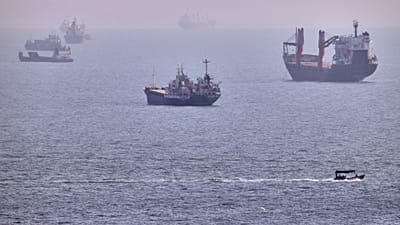
A small boat sails past cargo ships and other commercial vessels anchored in the Strait of Hormuz off Bandar Abbas, Iran, Wednesday, Aug. 5, 2026.
-
Copyright © africanews
Amirhosein Khorgooi/ISNA via AP
An unidentified projectile damaged the ship's engine room and "resulted in a crew casualty" off the coast of Oman, the United Kingdom Maritime Trade Operations (UKMTO) said on Tuesday, citing a report from the company's security office.
The maritime monitoring agency did not release any details about the ship or its cargo, and it was not clear whether the crew member was killed or wounded. It said the Omani Coast Guard was assisting other crew members and authorities were investigating.
Iran effectively closed the strait — through which roughly one-fifth of the world's traded oil supplies passed before the war — after Israel and the US attacked the country on February 28.
The US is currently blockading Iranian shipping traffic through the strait.
Iran's parliamentary speaker and negotiator in previous talks with the US, Mohammad Bagher Qalibaf, reiterated hours later that Tehran plans to maintain its grip on shipping traffic until Washington meet Iran's conditions.
"Until the United States fulfills its commitments under the agreement, including lifting the blockade, releasing frozen assets, lifting oil sanctions, ending threats and military operations on all fronts, and implementing the other conditions to which it committed, the Strait of Hormuz will not reopen," he said.
Iran-Oman talks
With negotiations between the US and Iran stalled, Iran has been holding separate talks with Oman on a plan to manage ships transiting the strait, and said Monday it was finalising details for a joint statement.
US President Donald Trump reacted angrily, reportedly telling Fox News reporter Trey Yingst in a telephone interview that Washington would bomb Oman if it "gets in the way."
Following a meeting between Egyptian Foreign Minister Badr Abdelatty and Omani counterpart Badr al-Busaidi, the Egyptian Foreign Ministry said Tuesday that the Iranian-Omani deal could pave the way for Washington and Tehran to return to negotiations for a "comprehensive and permanent deal that addresses all concerns and enhances regional security and stability."
The statement did not address Trump's latest threat against Oman.
Turkey urges diplomatic solution to the war
Turkish President Recep Tayyip Erdogan urged Trump in a telephone call to continue to seek a diplomatic solution to the conflict with Iran.
The call came late Monday as the 60-day negotiating period to find a peace deal between the United States and Iran was expiring, with no word of an extension and both sides seemingly as far apart as they were at the start.
"President Erdogan said it is important to make maximum use of diplomacy amid tensions between Iran and the United States," according to a statement from the Turkish presidential communications office.
Turkey, a NATO member that borders Iran, earlier this month signed a joint defence agreement with Saudi Arabia and Pakistan, which stipulates "that any armed attack against any one of the three states shall be regarded as an attack against them all."
Trump has praised the agreement, saying that "it shows how the Middle East is coming together, and how Countries will finally be able to defend themselves in a more meaningful way."
Erdogan told Trump the deal reflected "a strong stance to ensure regional stability and security."