Senegal’s livestock markets are facing a shortage of sheep just days before Tabaski, as insecurity in neighbouring Mali disrupts a key supply route and pushes prices sharply higher.
Senegal sheep prices surge ahead of Tabaski amid Mali crisis
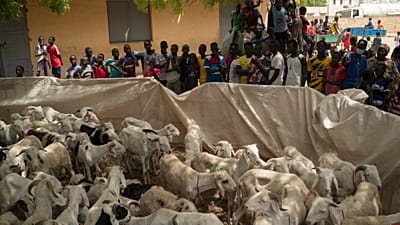
People gather around sheep gifted by the Secours Islamique France, Bargny, Senegal, Wednesday, July 14, 2021.
-
Copyright © africanews
Copyright 2021 The Associated Press. All rights reserved.
Traders say the crisis in Mali has slowed the movement of animals into Senegal, leaving buyers struggling to afford sheep for one of the most important festivals in the Muslim calendar.
"Jihadists have blocked the roads, and vehicles can neither enter nor leave," said seller Djiby Sow, who recently returned from Mali.
As supply tightens, prices in Senegalese markets have surged.
"Everything is expensive, even though we are still a few days away from Tabaski," said buyer Mamadou Mademba Seck.
Sow said the difference from last year is clear, with far fewer animals available in the market. He explained that he would normally travel regularly to Mali to buy sheep, but can no longer do so after encountering serious problems on his last trip.
According to buyers, the rise in prices has come earlier than usual this year. Seck said that in 2025, prices increased only at the last minute before Tabaski, but shortages are already being felt with less than two weeks to go before this year’s celebration.
Sheep that previously sold for around 150,000 CFA francs are now being offered for about 250,000 CFA francs, a jump many households say is unaffordable.
Ismaila Sow, president of the National Council of the Senegalese Breeders' Association, warned that if the disruption continues, livestock production costs and meat prices could rise further, partly because animal feed is also becoming more expensive.
The pressure on Senegal’s markets is tied to a wider crisis in Mali, where a jihadist blockade around Bamako has disrupted transport, livestock deliveries and holiday travel ahead of Eid.
Since late April, fighters linked to Al-Qaeda’s Sahel branch have targeted routes into the Malian capital, burning buses and freight trucks. The insecurity has deterred many transport operators and travellers, while also pushing up the cost of moving sheep into Bamako.
Transporters say the cost of moving one animal has climbed from around 2,500-2,750 CFA francs to between 15,000 and 18,000 CFA francs, contributing to severe shortages and soaring prices there as well.
The disruption has affected more than livestock. In Bamako, many families have been forced to abandon plans to travel home for Tabaski, while power cuts and water shortages have added to the strain on daily life.
For many in Senegal and Mali, the crisis is turning a major religious and family celebration into a period of financial pressure and uncertainty.