There are mixed emotions among locals in Granadilla de Abona municipality in the southern part of Spain’s Tenerife island off the coast of Africa.
Countries scramble to track passengers of virus-hit ship as cases rise
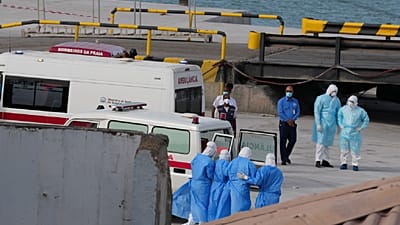
Health workers in protective gear evacuate patients from the MV Hondius cruise ship at a port in Praia, Cape Verde, 6 May 2026
-
Copyright © africanews
Misper Apawu/Copyright 2026 The AP. All rights reserved
The cruise ship affected by the hantavirus is due to dock there in a few days’ time, and the mood among locals ranges from "concerned" to "business as usual".
As it heads to the island, health officials in several countries are scrambling to trace and contain the outbreak of the potentially deadly human-to-human strain of the virus.
Gas delivery driver, Cristo Alvarez, said that people are obviously concerned given what happened with Covid-19.
"Because they thought it wouldn't reach us either, and look how quickly it spread," he said.
The fate of the MV Hondius has sparked international alarm after three passengers travelling on the ship died.
People thought to have contracted the virus are being treated or are isolating in Britain, Germany, the Netherlands, Switzerland, and South Africa.
The World Health Organisation said on Thursday that five confirmed infections have been identified among people connected to the ship.
Mayte Gonzalez, manager of the Médano Hotel in Granadilla de Abona, said the arrival of the ship was “unwelcome news”.
"What we really want is for healthy tourists to arrive here, but anyway, we're confident that this is merely a logistical procedure and that everything will turn out fine, obviously," she said.
Netherlands-based Oceanwide Expeditions said in a statement that none of the remaining people on board, who come from 23 different countries, show any symptoms of hantavirus.
The WHO, meanwhile, said while it expects more cases to emerge, it downplayed fears of a wider global outbreak from the virus, which is less contagious than Covid.
Hantavirus is a rare respiratory disease that is usually spread from infected rodents and can cause respiratory and cardiac distress as well as haemorrhagic fevers.
There are no vaccines and no known cure, meaning that treatment consists solely of attempting to relieve the symptoms.
The version detected aboard the ship is a rare strain known as the Andes virus, which can be transmitted between humans.
It is thought that a passenger had contracted the virus - which has a one-to six-week incubation period - before boarding the ship in Argentina and eventually infected others as it sailed across the Atlantic.