E-mobility companies based in Africa are beginning to assemble electric vans and taxis locally, using Chinese-made kits and innovative financing to increase the use of electric public transport across the continent.
Nigeria and Kenya lead production of electric vans using Chinese kits
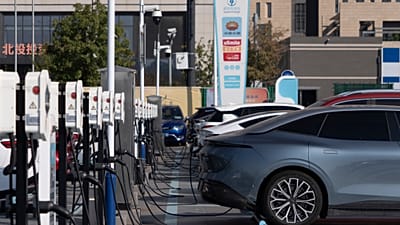
Electric vehicle charging stations are seen in Beijing, China, 11 October 2024
-
Copyright © africanews
Copyright 2024 The Associated Press. All rights reserved
One Lagos-based Nigerian company has begun assembling 18-seater passenger electric vans using kits supplied by Chinese automaker Dongfeng Motor Corp.
Saglev says it plans to produce up to 2,500 vehicles a year, eventually assembling 17 electric models for Nigeria and other West African markets.
“This is a major step in Nigeria's transition toward clean, fossil-free transportation,” said its CEO Olu Falaye.
He said the van is the first locally assembled electric vehicle of its kind for mass transit in Nigeria and sub-Saharan Africa.
“This feat is a clear signal that electric mobility in Nigeria is practical, scalable, and ready for adoption,” Falaye said.
Saglev is a joint venture between Nigeria’s Stallion Group, a major auto distributor, and Chinese automaker Sokon Motor.
It also plans to install solar-powered charging stations to provide more reliable sources of power, a key challenge the adoption of EV in some parts of Africa.
There's a similar push in Kenya, where Chinese backed Rideence Africa recently signed a $2.46 million deal with Mombasa-based Associated Vehicle Assemblers (AVA).
It will see the local assembly of electric taxis and minibuses from kits supplied by China's Jiangsu Joylong Automobile and Beijing Henrey Automobile Technology.
AVA Managing Director Matt Lloyd said the partnership delivers Kenya’s first dedicated electric vehicle assembly line, demonstrating it has the “capacity and capability to assemble EVs locally at scale”.
Kenya and Nigeria, two of Africa’s largest economies, are leading the push for local EV assembly as countries seek to cut fuel costs, reduce emissions, and build domestic manufacturing capacity.
Electric vans and minibuses are central to public transport across Africa, where Japanese models such as the Toyota Hiace and Nissan vans dominate the roads, carrying passengers and goods.
EV charging costs average about $3 for up to 200 kilometres compared with more than $15 in petrol costs for similar distances.
“The assembly of electric vans is emerging as a strong market segment,” said Dennis Wakaba, the secretary-general of the Electric Mobility Association of Kenya.
“Earlier, the cost of electric vans was high, putting off operators. But as local assembly scales up, these costs have dropped, attracting more orders.”
Kenya has one of Africa's most active electric mobility markets, with startups assembling buses and vans and deploying them for public transport and ride-hailing.
Ethiopia and South Africa also have entered the market. In Ethiopia, Belayneh Kinde Group assembles about 150 minibuses a month using Chinese components.
To make EVs more affordable, companies like Rideence are adopting pay-as-you-drive and lease-to-own options that let operators avoid expensive initial payments. It leases its taxis to drivers for about $18 per day.
BasiGo-Kenya Vehicle Manufacturer, which also is expanding into electric vans assembly, requires operators of its EVs to pay a deposit and then about 20 US cents per kilometre driven.
That approach fits with financial realities for transport operators in Africa, where access to credit is limited and few can afford to purchase new vehicles outright.
“These innovative financing models mitigate risks for both assembler and operators, helping put vehicles on the road faster. With these, we expect to see more e-vans taking a larger share of the African transport systems,” Wakaba said.
Still, there are only about 30,000 EVs in Africa, compared with millions of gas and diesel-fuelled vehicles, latest figures from the Africa Mobility Alliance shows.
The continent manufactured only 1.1 million vehicles in all last year, 90 per cent of them in Morocco and South Africa.