The humanitarian system is overstretched, underfunded and under attack, the United Nations humanitarian chief warned on Monday, as he launched an appeal for $23 billion for 2026.
Global humanitarian crisis worsens, UN seeks $23 Billion for 2026
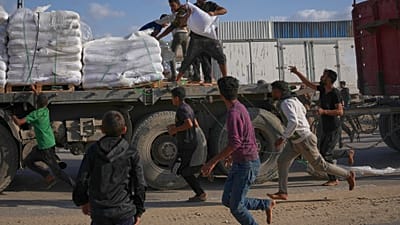
FILE - Palestinians grab sacks of flour from a moving truck carrying World Food Programme aid as it drives through Deir al-Balah in central Gaza, Nov. 15, 2025.
-
Copyright © africanews
Copyright 2025 The Associated Press. All rights reserved.
“There is pain on every page,” UN humanitarian chief Tom Fletcher said as he unveiled the 2026 Global Humanitarian Overview, warning that “a quarter of a billion people are in urgent need of humanitarian help” while funding has fallen to its lowest level in a decade.
Speaking at UN headquarters in New York, Fletcher said last year’s appeal brought in just $12 billion, making it “a heartbreaking report to share.”
He said 2025 saw hunger surge, with food budgets cut even as “famines hit parts of Sudan and Gaza.” Health systems “broke apart,” disease outbreaks rose, and millions lost access to food, medical care and protection. Programs for women and girls were slashed, hundreds of aid groups shut down, and “over 380 aid workers were killed, the highest on record.”
Fletcher warned that the humanitarian system is fraying. “We are overstretched, underfunded and under attack,” he said, adding that only 20 per cent of appeals were supported. “We drive the ambulance towards the fire on your behalf. But we are also now being asked to put the fire out. And there is not enough water in the tank. And we’re being shot at.”
Despite this, agencies “reached 98 million people” last year. Fletcher said, “I take heart from the conviction that so many leaders have, including the US president, that 2026 will be a year of peacemaking, a year that can create a once in a generation opportunity to do something extraordinary. So, let's do something extraordinary. We have a plan.”
Response plans
The UN’s goal for 2026 is to save 87 million lives through 29 response plans covering 50 countries. Needs include $4 billion for three million people in the occupied Palestinian territories, $2.8 billion for 20 million people in Sudan, $2 billion for seven million Sudanese displaced across borders, and $1.4 billion to reach 4.9 million people affected by the crisis in Myanmar.
Addressing the scale of the effort, Fletcher said: “Why 87 million, when so many more than this need our help? The plan sets out where we need to focus our collective energy first. It’s therefore based on excruciating life and death choices.”
He said the UN needs $23 billion to meet the most urgent needs in 2026. While global budgets are tight, Fletcher noted the world spent $2.7 trillion on defense last year. “I’m asking for just over one per cent of that,” he said, adding the entire appeal could be funded if the top 10 percent of global earners (anyone making over $100,000) gave $0.20 a day.
“Eighty-seven million lives. That’s more than died in the Second World War,” he said. “So, is the UN dead? Tell that to the relatives and the friends of the hundreds of our colleagues who died saving lives this year. Tell that to the 87 million lives that we will set out to save next year.”